
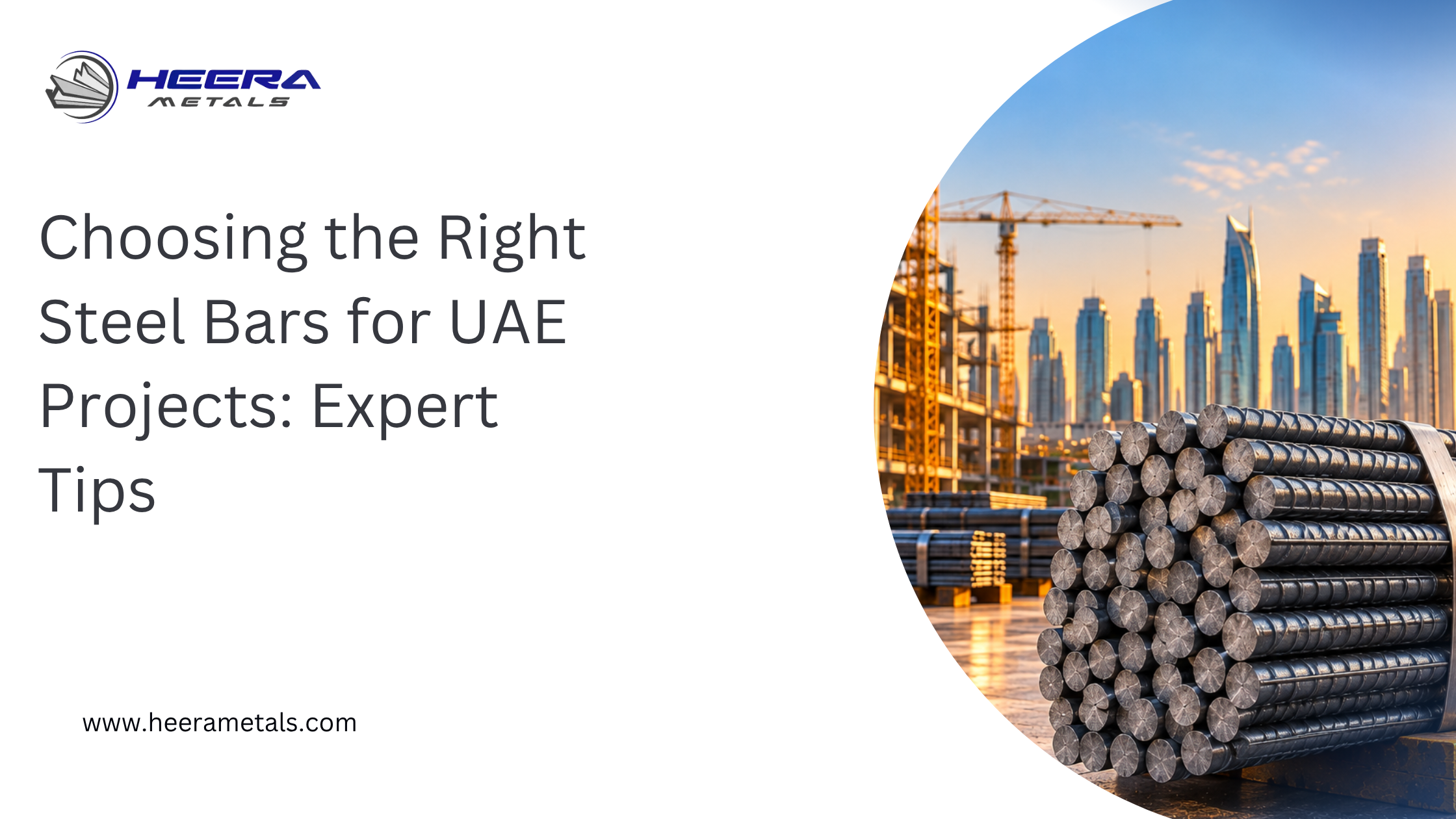
Steel Bars for UAE Projects: Types, Grades & Buying Guide
The right steel bar for a UAE project depends on what the bar has to do: reinforce concrete, form a machined or fabricated part, or carry structural loads. For concrete work, contractors normally specify ribbed TMT or deformed reinforcement bars in a 500 MPa grade, certified to a recognised standard. For fabrication, mild steel round bars are the usual choice. Beyond type and grade, the points that decide quality in the UAE are certification, corrosion protection, size tolerance, and a supplier who can document every batch.
The main types of steel bars used in UAE construction, how to read grades and standards, what to check before ordering, and how to source from an Indian steel bar exporter with confidence.
What Types of Steel Bars Are Used in UAE Construction?
Three families of bars cover most requirements in UAE construction and industrial work.
| Bar type | Main use | Typical specification |
| TMT / deformed reinforcement bars (rebar) | Reinforcing concrete in foundations, columns, slabs, and infrastructure | IS 1786 Fe 500 / Fe 500D, BS 4449 B500B, ASTM A615 Grade 60 |
| Mild steel (MS) round bars | Fabrication, machine parts, anchor bolts, gates, grills, light structural work | IS 2062 E250 or equivalent |
| Structural bars and sections | Frames, supports, bracing (flats, squares, angles) | IS 2062 or equivalent structural grade |
TMT and Reinforcement Bars
TMT (thermo-mechanically treated) bars have a hard outer layer and a more ductile core. This combination gives high yield strength with enough ductility to bend and absorb load. Ribs on the surface improve the bond with concrete, which is why these bars are the standard choice for reinforced concrete in high-rise buildings, bridges, and industrial slabs.
Mild Steel Round Bars
MS round bars are plain, smooth bars used where machining, welding, or simple fabrication matter more than concrete bond. The commonly used IS 2062 E250 grade has a minimum yield strength of 250 MPa (up to 20 mm thickness), a minimum tensile strength of 410 MPa, and a minimum elongation of 23% (InfraLens: IS 2062:2011). They should not replace ribbed rebar inside concrete.
How Do You Read Steel Bar Grades and Standards?
The number in a rebar grade is its minimum yield strength in MPa, so Fe 500, Fe 500D, and B500B all refer to a 500 MPa class. The difference lies in ductility and testing requirements.
| Property | IS 1786 Fe 500 | IS 1786 Fe 500D | BS 4449 B500B |
| Minimum yield strength | 500 MPa | 500 MPa | 500 MPa |
| Minimum elongation | 12% | 16% | At least 5.0% total elongation at maximum force (Agt) |
| Tensile-to-yield ratio | 1.08 | 1.10 | At least 1.08 |
InfraLens: IS 1786, InfraLens: IS 1786:2008, and InfraLens: rebar grades handbook. Elongation is measured differently under each standard, so the percentages are not directly comparable. Always read the figures from the applicable standard.
What Does the “D” in Fe 500D Mean?
The “D” stands for ductile. Fe 500D carries a higher minimum elongation and a stricter tensile-to-yield ratio than plain Fe 500, which helps structures deform safely under extreme loading. It is commonly specified for high-rise and seismic-sensitive designs.
Which Standards Apply in the UAE?
UAE projects commonly specify BS 4449 Grade B500B, with ASTM A615 Grade 60 also used on some projects. The consultant’s specification is the final authority. In Dubai, the Dubai Central Laboratory Department of Dubai Municipality runs a third-party certification scheme for reinforcing steel, and certified factories carry approved bar markings Check whether the project needs DCL-certified bars before you buy, and confirm that an Indian-produced bar meets the specification the consultant has approved.
How to Choose the Right Steel Bars for UAE Projects
Work through these steps in order. They apply whether you are buying 20 tonnes or 2,000.
- Start from the structural drawings. Note the grade, diameters, and standard the engineer has specified.
- Confirm approvals. Check consultant, municipality, and client requirements for certified or approved sources.
- Match ductility to the structure. High-rise, heavily loaded, or seismic-sensitive designs may call for higher-ductility grades such as Fe 500D or B500B.
- Check size and weight tolerance. IS 1786 sets permitted mass variation by bar size, with wider tolerance on thin bars and tighter tolerance on larger bars (InfraLens: IS 1786:2008).
- Plan corrosion protection. Coastal and humid sites may call for epoxy-coated or other protected bars, depending on the specification.
- Request documentation. Insist on mill test certificates tied to heat or batch numbers.
- Compare supply terms. Look at lead time, packing, delivery schedule, and price validity, not just the rate per tonne.
Corrosion and Durability in UAE Conditions
Heat, humidity, and salt in coastal areas raise corrosion risk for reinforcement. Concrete cover and mix quality do most of the protective work, but projects in aggressive environments sometimes specify epoxy-coated or galvanised reinforcement. This is a design decision for the consultant, so confirm requirements before ordering.
Storage and Handling Before Use
Store bars off the ground, keep them clear of mud and standing water, and separate them by size and grade. Surface rust is common on site, but deep pitting reduces the usable section and should be assessed before the bar is used.
Supply, Duties, and Market Context in the UAE
The UAE has an established domestic steel industry. Emirates Steel, the largest producer, reported 3.25 million tons of crude steel and about 1.77 million tons of rebar in 2024, though that figure covers the company only, not the whole market .
Imports still matter for specific sizes, grades, and volumes. To protect local producers, the UAE applies a 10% customs duty on rebar and wire rod, up from 5%, and the latest extension runs until 12 October 2026). Buyers should confirm whether it has been renewed, since duty directly affects landed cost.
Sourcing Steel Bars From India to the UAE
India is a large steel producer with a broad range of TMT bars, MS round bars, and sections. For UAE buyers the main advantages are product range, competitive bulk pricing, and shorter shipping times than many other sources.
What to Ask an Indian Steel Bar Exporter
- Which standard and grade do the bars meet, and can the supplier show test certificates for the specific batch?
- Can the supplier supply bars to the UAE project’s approved specification, including any required third-party testing?
- What size range, bar lengths, and monthly volumes are available?
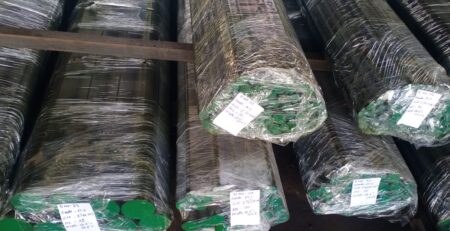
- How are bars bundled, tagged, and protected for sea freight?
- What delivery terms and lead times apply, and can shipments be phased?
Red Flags When Choosing a Supplier
- Refusal to provide mill test certificates or batch traceability.
- Unmarked bars with no manufacturer or grade identification.
- A rate far below other quotations without a clear explanation.
- Vague answers on standards, tolerances, or delivery dates.
Quality Checks on Delivery
- Match bar markings and bundle tags to the purchase order and certificates.
- Check diameter and unit weight on a sample against the standard’s tolerance.
- Inspect for bends, cracks, laps, and heavy rust.
- Arrange independent testing of mechanical properties when the specification requires it.
- Reject non-conforming lots before they are used, and keep the records.
Frequently Asked Questions
Which steel bars are best for construction in the UAE?
Ribbed 500 MPa-class TMT or deformed bars, such as BS 4449 B500B or IS 1786 Fe 500D, are commonly used for reinforced concrete, subject to the project specification.
What is the difference between Fe 500 and Fe 500D?
Both have a 500 MPa minimum yield strength. Fe 500D has a higher minimum elongation and a stricter tensile-to-yield ratio, which means better ductility.
Can mild steel round bars be used as reinforcement in concrete?
No. Plain MS round bars lack the ribs that bond with concrete and are meant for fabrication and machining, not for reinforcing structural concrete.
Do Indian steel bars meet UAE requirements?
They can, provided they meet the specification the consultant has approved and carry the required certification. Verify the standard, test certificates, and any approval requirement before ordering.
Is there an import duty on rebar in the UAE?
Yes. A 10% duty on rebar and wire rod has been in place, with the latest extension running to 12 October 2026. Check its current status before pricing.
What documents should I request from a steel bar supplier?
A mill test certificate, packing list, commercial invoice, and any third-party inspection or approval certificates the project requires.
How do I choose a steel bar supplier in the UAE?
Prioritise documented quality, the right grade and size range, reliable delivery, and clear terms, rather than price alone.
Conclusion
Choosing the right steel bars for UAE projects comes down to matching bar type and grade to the application, confirming that the standard and certification suit the project, and protecting the steel against local conditions. Documented quality, checked on delivery, matters as much as price.



Leave a Reply