
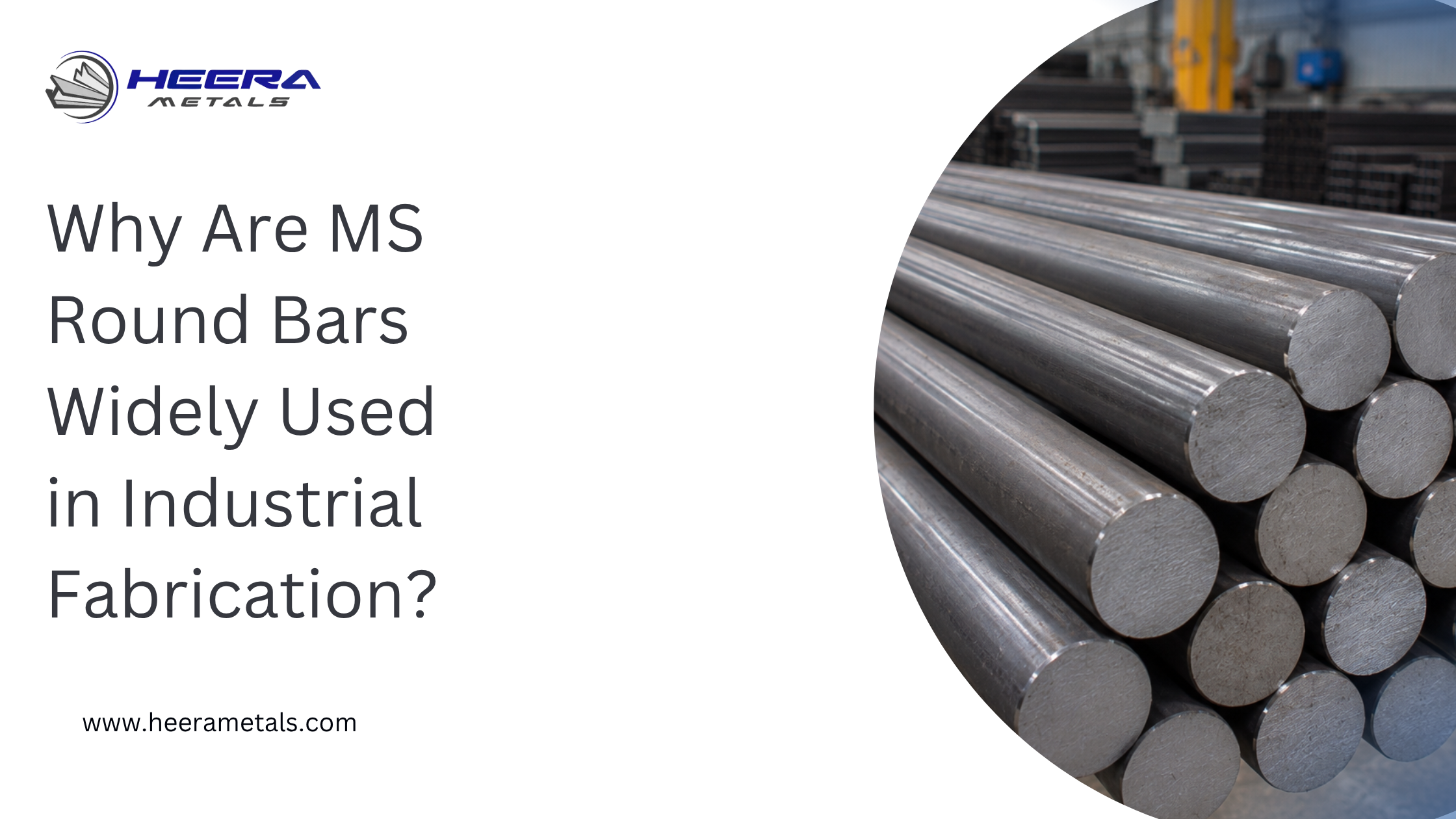
Why Are MS Round Bars Widely Used in Industrial Fabrication?
In factories, fabrication workshops, and construction sites across the world, one material shows up again and again MS round bars. Straightforward in shape, reliable in performance, and remarkably versatile in application, mild steel round bars have earned their place as one of the most trusted materials in industrial fabrication.
But why exactly are they so popular? With a wide range of steel products available stainless steel, alloy steel, tool steel what makes mild steel round bars the preferred choice for engineers, fabricators, and manufacturers?
The answer comes down to a combination of mechanical properties, workability, cost efficiency, and sheer adaptability. Whether you’re machining precision components, building structural frameworks, or fabricating heavy-duty equipment, MS round bars deliver consistent, dependable results at a price point that makes sense for large-scale industrial use.
This article explores the key reasons why MS round bars in industrial fabrication remain the go-to choice and how to make the best use of them in your projects.
What Are MS Round Bars?
MS round bars, or mild steel round bars, are solid cylindrical steel bars produced from low-carbon steel typically containing 0.15% to 0.30% carbon by weight. This low carbon content is precisely what gives them their defining characteristics: excellent ductility, ease of welding, and strong machinability, without the brittleness that higher carbon steels can exhibit.
They are produced primarily through hot rolling, where steel billets are passed through rollers at high temperatures to form uniform cylindrical profiles. The result is a product with consistent dimensions, reliable mechanical properties, and a surface finish suited to further industrial processing.
Available in diameters ranging from as small as 6mm up to 300mm or more, mild steel rods are manufactured to conform to international standards including IS 2062, EN 10060, and ASTM A108, making them universally compatible across engineering and fabrication disciplines.
Key Benefits of MS Round Bars in Industrial Fabrication
Understanding why these steel rods dominate industrial applications starts with their core material advantages.
High Strength and Structural Durability
Despite their relatively low carbon content, MS round bars offer impressive tensile strength typically between 400 MPa and 550 MPa depending on grade. This makes them highly effective as load-bearing steel materials in structural assemblies, mechanical components, and heavy-duty fabrication work.
Their ductility the ability to deform under stress without fracturing is equally important in dynamic industrial environments where impact loads and vibration are common.
Excellent Machinability
One of the standout advantages of mild steel round bars is how easily they respond to machining operations. Turning, drilling, threading, milling all standard processes in mechanical engineering components manufacturing can be performed with standard tooling and without excessive tool wear.
This ease of machinability reduces production time, lowers tooling costs, and enables high-volume manufacturing of precision steel components with repeatable accuracy. For industries where tight tolerances are non-negotiable, that matters enormously.
Superior Weldability and Forming
Few steel products are as weld-friendly as mild steel. The low carbon content minimises the risk of heat-affected zone cracking and hydrogen-induced cracking during welding and forming applications. MS round bars can be welded using MIG, TIG, arc, and resistance welding processes without requiring pre-heating in most standard thicknesses.
This makes them the preferred choice for fabrication shops producing welded assemblies, structural connections, and mechanical sub-assemblies where MS round bars for machining and welding efficiency directly affects production output.
Cost-Effective Across the Supply Chain
Mild steel is one of the most cost-effective steel materials available. Raw material costs are lower than stainless or alloy steel, production processes are well-established, and the wide availability of carbon steel round bars in standard dimensions means shorter lead times and lower procurement costs.
For industries operating at scale construction, automotive, general engineering this cost efficiency has a significant cumulative impact on project budgets and margins.
MS Round Bar Applications Across Heavy Industries
The industrial uses of steel round bars span a remarkable range of sectors. Here’s where mild steel round bars make the most impact.
MS Round Bars in Construction
In the construction sector, steel round bars serve multiple structural roles:
- Reinforcement bars embedded in concrete columns, slabs, and foundations
- Tie rods and anchor bolts securing structural elements
- Formwork supports and scaffolding components during the build phase
- Pin and shaft connections in structural steel frameworks
MS round bars in construction are valued for their ability to bond with concrete, their formability on-site, and their compliance with structural load requirements.
Industrial Uses in Manufacturing and Engineering
In manufacturing environments, industrial fabrication round bars are machined into a vast array of engineering components:
- Shafts, axles, and spindles for rotating machinery
- Fasteners including bolts, studs, and pins
- Hydraulic and pneumatic cylinder rods
- Gear blanks and flanges prior to precision machining
- Tool holders and fixture components in machine shops
These applications demand consistent material properties across the bar’s cross-section something that hot rolled round bars consistently deliver.
Automotive and Transport Fabrication
The automotive and heavy transport industries rely on mild steel rods for suspension components, linkage arms, tow bars, and chassis reinforcements. The combination of high strength, controlled ductility, and easy machinability makes MS round bars ideal for parts that must withstand repeated mechanical stress without fatigue failure.
Agricultural and Material Handling Equipment
Farm machinery, conveyors, hoppers, and material handling systems all make extensive use of fabrication steel materials in round bar form. The robustness of mild steel, combined with its compatibility with standard surface treatments, ensures long service life even in demanding outdoor and agricultural environments.
MS Round Bars vs Stainless Steel Round Bars: Which Should You Choose?
A common question in industrial procurement is whether to specify mild steel or stainless steel round bars. The answer depends on the application.
| Property | MS Round Bars | Stainless Steel Round Bars |
| Cost | Lower | Significantly higher |
| Corrosion resistance | Requires coating | Inherent resistance |
| Machinability | Excellent | Good (varies by grade) |
| Weldability | Excellent | Good (grade-dependent) |
| Tensile strength | 400–550 MPa | 520–750 MPa (grade-dependent) |
| Best for | General fabrication, structural, mechanical | Food processing, marine, chemical industries |
For the vast majority of industrial manufacturing processes where parts are painted, powder-coated, or used in protected environments MS round bars are the more practical and economical choice. Stainless steel earns its premium in corrosive environments where surface treatment isn’t viable.
How to Choose MS Round Bars for Fabrication Work
Selecting the right mild steel round bar involves more than picking a diameter. Here’s a practical framework:
Step 1: Define the Load Requirements
Determine whether the bar will be subjected to tensile, compressive, torsional, or bending forces or a combination. This informs the required grade and minimum tensile strength.
Step 2: Select the Appropriate Diameter and Grade
Match bar diameter to calculated stress levels. Common grades for round bars for engineering projects include:
- IS 2062 Grade A/B: General structural and fabrication use
- EN8 (080M40): Higher strength applications, axles, and shafts
- EN1A: Free-cutting grade for high-volume machining
Step 3: Consider the Surface Condition
Hot rolled bars have a mill scale surface suitable for most fabrication work. Where tighter dimensional tolerances are required such as for shaft fits and bearing seats specify precision steel components in cold-drawn or turned and polished condition.
Step 4: Plan for Corrosion Protection
In outdoor, damp, or chemically exposed environments, specify an appropriate corrosion protection method galvanising, epoxy coating, or zinc-rich primer to extend service life without the cost premium of stainless steel.
Common Applications Summary: Where MS Round Bars Excel
To put it all together, here are the environments and applications where steel round bars for fabrication deliver the best results:
- Structural fabrication: Ties, hangers, supports, and anchor components
- Machine manufacturing: Shafts, pins, rollers, and spindles
- Construction: Reinforcement, formwork, and connection hardware
- Automotive: Linkages, tow components, and structural sub-assemblies
- General engineering: Bolts, studs, and turned components
- Agricultural machinery: Frame components, conveyor axles, and linkage rods
Conclusion: Why MS Round Bars Remain the Industry Standard
The enduring popularity of MS round bars in industrial fabrication is no accident. They strike a near-perfect balance between mechanical performance, manufacturing versatility, and cost efficiency qualities that matter in every industrial sector, from heavy construction to precision engineering.
Their structural strength and durability, paired with outstanding weldability and machinability, make them adaptable to an enormous range of fabrication tasks. And with proper surface treatment, their one limitation susceptibility to corrosion is easily managed.
For engineers specifying materials, fabricators sourcing stock, or project managers evaluating costs, mild steel round bars represent a proven, reliable, and economical solution that continues to underpin modern industrial metal fabrication.



Leave a Reply