
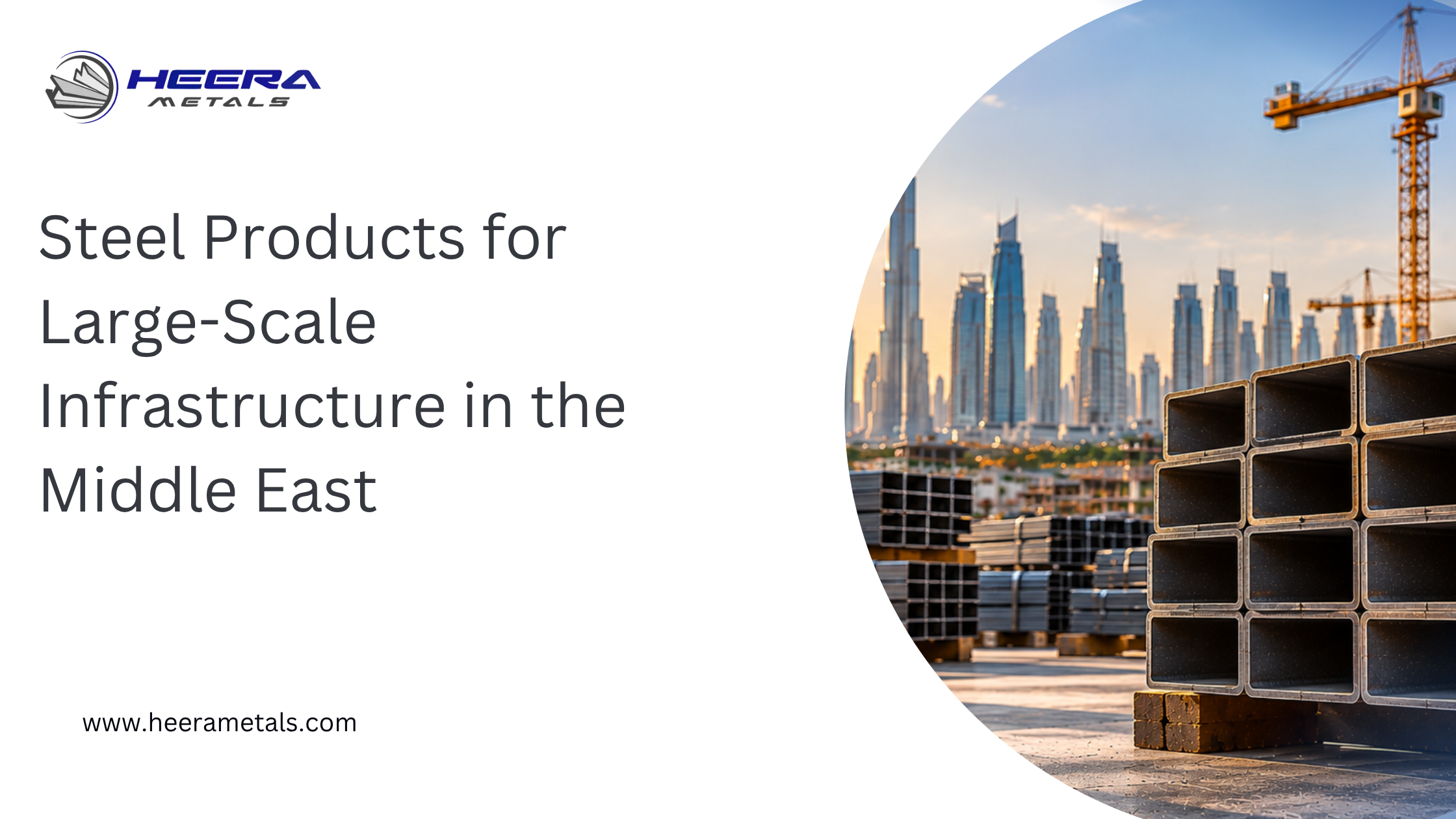
How to Select Steel Products for Large-Scale Infrastructure in the Middle East
Selecting steel for a large infrastructure project in the Middle East comes down to five decisions: match the product to its structural role, specify the right grade and standard, plan for heat and corrosion, confirm approvals and documentation, and choose a supplier who can deliver in volume on schedule. Get these right and the steel will perform for the design life; get them wrong and the cost shows up as rejected lots, delays, and early maintenance.
This guide walks through how engineers, contractors, and procurement teams can select steel products for infrastructure in the UAE, Saudi Arabia, and the wider Gulf, from beams, channels, and angles to plates, coils, and reinforcement bars, including what to check when sourcing from an Indian steel supplier.
Why Large-Scale Infrastructure Drives Steel Demand in the Middle East
Infrastructure programmes in the Gulf are large enough to shape regional steel demand, and the products they use vary widely.
- Saudi Arabia: The Deputy Minister of Industry and Mineral Resources has said construction mega-projects launched in recent years are worth more than 5 trillion riyals (about USD 1.33 trillion), with most still under development .
- UAE rail: The Etihad Rail national network is planned at around 1,200 km, linking the UAE with Saudi Arabia at Ghweifat and Oman via Al Ain. The programme includes more than 400 structures, among them 231 bridges.
- UAE industry: Operation 300bn targets raising the industrial sector’s GDP contribution from AED 133 billion to AED 300 billion by 2031 ,which supports demand for factory, warehouse, and utility steelwork.
The practical consequence is that buyers often need several product families at once, in large quantities, on tight programmes.
Which Steel Products Suit Which Infrastructure Applications?
Start from the structural role, not the product catalogue. The table below maps common infrastructure elements to the steel products usually considered for them. The final selection always follows the engineer’s design.
| Infrastructure element | Common steel products | Why |
| Bridges and rail structures | Heavy beams and girders, plates, reinforcement bars | High bending loads, long spans, concrete decks |
| Industrial buildings and warehouses | Beams, channels, angles, plates, coils | Primary frames, purlins, bracing, cladding |
| Roads, ports, and logistics hubs | Reinforcement bars, plates, sections | Concrete pavements and foundations, heavy-duty structures |
| Energy and utilities | Plates, pipes, angles, channels | Tanks, pipe racks, towers, supports |
| Foundations and concrete frames | TMT / deformed reinforcement bars | Tension reinforcement for concrete |
Structural Beams, Channels, and Angles
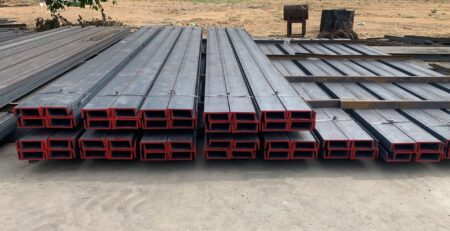
Beams (I and H sections) carry the primary bending loads. Channels suit purlins, girts, and stair stringers, while angles provide bracing, trusses, and edge support. Indian sections are designated under IS 808, for example ISMB for medium beams, ISMC for medium channels, and ISA for angles. For a deeper comparison of beams and channels, see our guide on choosing between the two.
Plates and Coils
Hot-rolled plates are used for base plates, gussets, tanks, and heavy fabrication. Coils are processed into sheets, pipes, roofing, and cladding. Plate thickness matters because guaranteed yield strength decreases as thickness rises, so designers should use the value for the actual thickness.
Reinforcement Bars
For concrete work, TMT or deformed bars in a 500 MPa class are standard. The “D” in IS 1786 Fe 500D indicates higher ductility, with a higher minimum elongation than plain Fe 500 . In Dubai, reinforcing steel under BS 4449 B500B is covered by a Dubai Municipality certification scheme. Check the approvals your project and authority require.
How to Select the Right Grade and Standard
The grade must match the structural design, and the standard must match what the consultant, authority, and client accept.
- Start from the approved drawings and specification. They state the grade, section, and standard. Do not substitute without written approval.
- Understand the grade designation. For IS 2062, the number is the minimum yield strength in MPa. E250 has a minimum yield of 250 MPa (up to 20 mm), a minimum tensile strength of 410 MPa, and a minimum elongation of 23% .
- Consider higher grades where design allows. E350 offers a higher yield strength (350 MPa) and can reduce section sizes in bridges and heavy structures.
- Check equivalence carefully. A European S355 or American grade may be specified, so confirm that an Indian grade is accepted as an equivalent before ordering.
- Specify subgrades for special conditions. Welded or low-temperature service may need quality classes with impact testing, as defined in the standard.
Designing for Heat, Humidity, and Corrosion
Middle East conditions are demanding. High temperatures, coastal humidity, and salt-laden air accelerate corrosion on exposed steel, so protection is a design decision, not an afterthought.
- Hot-dip galvanizing for towers, outdoor frames, and coastal structures.
- Paint and coating systems specified by exposure class and design life.
- Epoxy-coated or otherwise protected reinforcement where the consultant requires it for aggressive environments.
- Concrete cover and mix design for reinforced elements, which protect embedded steel.
Confirm the protection system with the project consultant, and make sure suppliers can deliver the specified finish or leave the steel suitable for shop treatment.
Compliance, Certification, and Documentation
Large projects are won or lost on paperwork as much as on steel quality. Plan for these items from the start:
- Mill test certificates tied to heat or batch numbers, showing chemistry and mechanical properties.
- Third-party inspection where the specification requires it.
- Product approvals or conformity requirements set by the destination country or emirate. These differ between the UAE and Saudi Arabia and can change, so verify them with the authority or your consultant.
- Traceability and marking so each bundle can be matched to its certificate on site.
- Customs duties. The UAE has applied a 10% duty on rebar and wire rod, with the latest extension running until 12 October 2026 (Arab Iron and Steel Union). Confirm the current position before pricing.
How to Evaluate a Steel Supplier for Infrastructure Projects
The right supplier for a Middle East infrastructure project combines product range, documented quality, volume capacity, and delivery discipline.
| Criterion | What to look for |
| Product range | Beams, channels, angles, plates, coils, and bars under one supplier to simplify coordination |
| Quality records | Batch-linked mill certificates and willingness to allow inspection |
| Capacity | Ability to supply bulk volumes and phased deliveries |
| Logistics | Export packing, shipping experience to Gulf ports, and clear delivery terms |
| Transparency | Quotations that state grade, standard, tolerance, and price validity |
| Responsiveness | Quick, accurate technical clarifications |
Red Flags
- No mill test certificates, or certificates that do not match the material.
- Unmarked bundles or missing batch identification.
- Prices far below other quotations without explanation.
- Vague answers on standards, tolerances, or lead times.
Sourcing Steel From India for Middle East Projects
India is a major steel producer, and Indian mills roll a broad range of structural sections daily, including ISMB, ISLB, ISMC, and ISA (InfraLens: IS 808). For Gulf buyers, the typical advantages are product range, bulk pricing, and shorter shipping times than many other sources.
When working with an Indian steel exporter, confirm the specification and grade in writing, the test certificate format, any third-party inspection arrangements, export packing, and shipment schedule. For large projects, agree phased delivery against site progress so that storage and handling stay manageable.
Procurement Steps for Large Projects
- Consolidate requirements by product, grade, and delivery window.
- Issue a clear enquiry with standard, grade, size, quantity, and certification needs.
- Compare quotations on identical specifications and terms.
- Verify supplier documentation and, where needed, inspect the source.
- Agree inspection, packing, and delivery terms in the purchase order.
- Check deliveries against certificates and tolerances before accepting them.
Frequently Asked Questions
How do I select steel products for a large infrastructure project?
Start from the structural design, match each element to the right product and grade, confirm the standard and approvals, plan for corrosion, and choose a supplier with documented quality and delivery capacity.
Which steel products are most used in Middle East infrastructure?
Beams, channels, angles, plates, coils, and reinforcement bars are the core products, used across bridges, rail, industrial buildings, ports, and utilities.
Which steel grade is common for structural work?
IS 2062 E250 is widely used for general structural steel, with higher grades such as E350 used where design calls for more strength.
Do Indian steel products meet Middle East project requirements?
They can, if they meet the approved specification and carry the required certification. Always confirm acceptance with the consultant and authority before ordering.
How should steel be protected in Gulf conditions?
Common methods are hot-dip galvanizing, paint systems, and protected reinforcement, chosen by the consultant according to exposure and design life.
What documents should come with a steel shipment?
Mill test certificates, a packing list, a commercial invoice, and any third-party inspection reports required by the project.
Is there an import duty on steel in the UAE?
A 10% duty has applied to rebar and wire rod, with the latest extension running to 12 October 2026. Duties vary by product and can change, so confirm current rates before pricing.
Conclusion
Selecting steel for large-scale infrastructure in the Middle East is a structured process: match each product to its structural role, specify the grade and standard the project accepts, protect the steel for Gulf conditions, and insist on documented quality from a supplier that can deliver at scale. These decisions cut risk more reliably than chasing the lowest price.
Contractors, developers, and procurement teams planning steel supply for UAE, Saudi Arabia, or wider Gulf projects can share product lists, grades, and quantities with Heera Metals to get a comparable quotation and export supply details from India.



Leave a Reply