
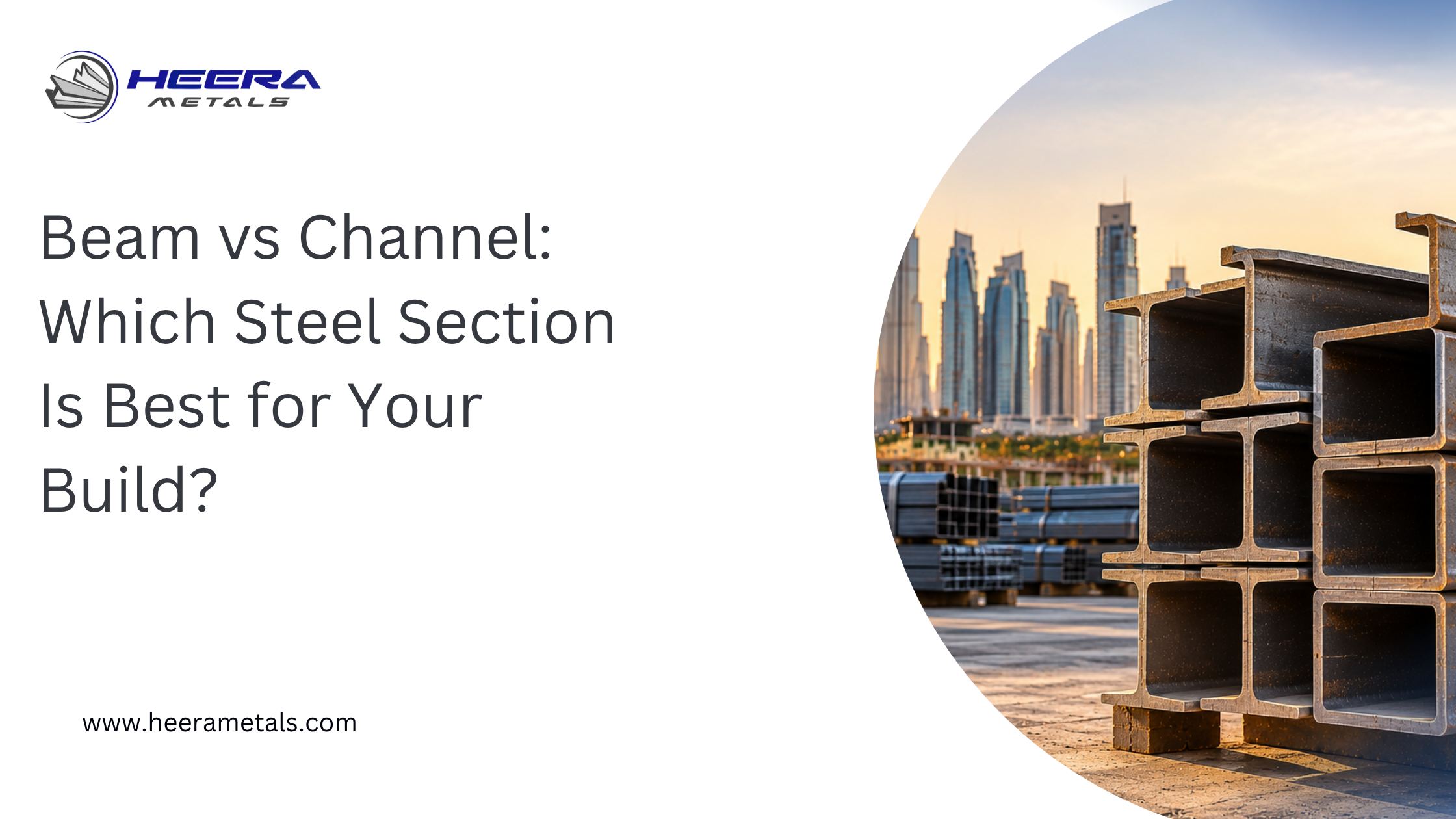
Beam vs Channel: Which Steel Section Is Best for Your Build?
Choose a steel beam when the member has to carry heavy bending loads over a span, such as a floor beam, main frame member, or crane runway. Choose a steel channel when you need a lighter, flat-backed section for purlins, girts, bracing, stair stringers, or secondary framing. Beams (I-sections) are symmetrical and efficient in bending, while channels (C or U sections) are easier to connect to flat surfaces but can twist if the load is not applied through the right point.
This article explains the difference between a steel beam and a channel, compares their strength and typical uses, and gives a practical way to choose between them for UAE construction and industrial projects, along with what to check when sourcing structural steel from a supplier.
What Is the Difference Between a Steel Beam and a Steel Channel?
A steel beam has an “I” or “H” cross-section: two flanges joined by a central web. A steel channel has a “C” or “U” cross-section: one web with a flange on each side, all pointing the same way. That single difference in shape changes how each section carries load.
| Feature | Steel beam (I-section) | Steel channel (C / U-section) |
| Shape | Symmetrical, flanges on both sides of the web | Open on one side, flanges on one side of the web |
| Best at | Heavy bending loads and long spans | Light to medium loads and secondary members |
| Typical use | Main beams, columns, girders | Purlins, girts, bracing, stringers, frames |
| Connection | Bolted or welded through web and flanges | Flat back sits flush against walls and plates |
| Twisting risk | Low under centred loads | Higher if loads act away from the web centre |
| Weight per metre | Generally higher for primary sections | Generally lower for comparable depth |
In India, the standard designations come from IS 808. ISMB denotes an Indian Standard medium-weight beam and ISMC an Indian Standard medium-weight channel, followed by the depth in millimetres, so ISMB 300 is a beam 300 mm deep and ISMC 200 is a channel 200 mm deep (InfraLens: IS 808).
Common Beam and Channel Sizes
The figures below illustrate how much the section choice changes weight and bending capacity. Unit weights and section properties can differ slightly between editions of IS 808, so confirm values against the version your project specifies.
| Section | Typical role | Weight (kg/m) | Section modulus, Zxx (cm³) |
| ISMB 300 | Primary beam | 44.2 | 573.6 |
| ISMB 600 | Heavy girder | 122.6 | Check the IS 808 table |
| ISMC 200 | Purlin, stringer, light frame | 22.1 | 242.1 |
| ISMC 300 | Heavier purlin or support | 35.8 | Check the IS 808 table |
When Should You Use a Steel Beam?
Use a beam when the member is a primary structural element: it supports floors, roofs, or equipment across a span and carries heavy bending and shear.
- Main frames of industrial buildings and warehouses where portal frames and primary beams carry roof loads.
- Floor beams and mezzanines supporting slabs, racking, or machinery.
- Columns and heavy girders using wider-flange or heavier sections.
- High-rise and commercial frameworks where long spans and heavy loads call for deeper sections.
Because the flanges carry most of the bending stress and sit far from the centre of the section, a beam uses steel efficiently where bending dominates. Heavier ISMB sizes can go up to 600 mm in depth.
When Should You Use a Steel Channel?
Use a channel for secondary and supporting elements where its flat back and lower weight are an advantage.
- Roof purlins and wall girts. Channels in roughly the 100 to 200 mm depth range are common for industrial shed purlins.
- Staircase stringers and platforms, where the C-shape hides connections and gives a clean finish.
- Bracing and light frames, including door, window, and equipment frames.
- Fabrication work, such as skids, supports, and trench or cable supports, where the flat back bolts or welds flush to plates.
Why Channels Can Twist
A channel’s centre of load (its shear centre) sits outside the web. If a load is applied through the web or flange without restraint, the section can twist as well as bend. Designers manage this with connections, bracing, or by pairing channels back to back. This is one reason channels are rarely the first choice for primary load-bearing beams.
Beam vs Channel: How to Decide
Work through these questions in order.
- Is it a primary or secondary member? Primary load paths usually call for beams. Secondary members such as purlins, girts, and bracing usually suit channels.
- How large is the span and load? Longer spans and heavier loads favour beams. Light to moderate loads over short spans can use channels.
- Does it need a flat surface? If the member must sit flush against a wall, plate, or another section, a channel’s flat back helps.
- Is torsion a concern? Where loads act off-centre or bracing is limited, beams or restrained channels are safer.
- What does the engineer specify? The structural design governs. The section, grade, and standard must match the approved drawings.
- What about weight and cost? Lighter sections reduce steel quantity, but only if they meet the design requirement. Never downsize a section to cut cost without engineering approval.
Can a Channel Replace a Beam?
Not without engineering approval. A channel and a beam of similar depth behave differently in bending, torsion, and buckling. Substitution should only follow a design check by the project engineer.
Grades and Standards for Mild Steel Beams and Channels
Mild steel beams and channels from Indian mills are commonly made to IS 2062, with dimensions and weights per IS 808. The widely used E250 grade has a minimum yield strength of 250 MPa for thicknesses up to 20 mm, a minimum tensile strength of 410 MPa, and a minimum elongation of 23%.Guaranteed yield strength drops as section thickness increases, so designers should use the value for the actual thickness .
For welded or low-temperature work, the engineer may specify a higher quality subgrade or a higher-strength grade. Always match the grade to the approved specification.
Why UAE Projects Keep Demanding Structural Sections
Structural beams and channels sit under much of the UAE’s building activity. Operation 300bn, the national industrial strategy, aims to raise the industrial sector’s GDP contribution from AED 133 billion to AED 300 billion by 2031 . More factories, warehouses, and logistics facilities generally mean more steel framing. One commercial market study estimates that Dubai accounts for around 42% of UAE demand for prefabricated building and structural steel .Treat market-research figures as indicators rather than exact numbers.
What to Check Before Buying Beams and Channels in the UAE
- Section designation and dimensions against the drawings, for example ISMB 300 or ISMC 200.
- Grade and standard, with mill test certificates linked to the heat or batch number.
- Length and tolerances, including cut lengths to cut wastage.
- Surface condition and protection, as coastal humidity accelerates corrosion. Hot-dip galvanizing or a paint system is specified according to exposure.
- Weight verification, since section weight per metre drives both cost and load calculations.
- Packing and handling suitable for sea freight and site storage.
Sourcing Beams and Channels From India
Indian mills roll a wide range of ISMB, ISLB, ISMC, and angle sections, and UAE buyers commonly import them for bulk projects. When comparing suppliers, ask for the standard and grade, the batch test certificates, the size range available, export packing, and delivery terms. Consider phased shipments for large projects to match site progress.
Frequently Asked Questions
What is the main difference between a steel beam and a channel?
A beam has an I or H shape with symmetrical flanges, while a channel has a C or U shape open on one side. Beams suit heavy bending loads. Channels suit lighter, secondary members.
Which is stronger, a beam or a channel?
For the same depth and in bending, a beam is generally the better choice for primary loads because of its symmetrical shape and torsional stability. Strength depends on the specific section and grade, so check the design tables.
What are channels mainly used for in construction?
Purlins, wall girts, stair stringers, bracing, light frames, and fabrication supports.
What do ISMB and ISMC mean?
ISMB is an Indian Standard medium-weight beam, and ISMC is an Indian Standard medium-weight channel. The number following is the section depth in millimetres.
Can I use a channel instead of a beam?
Only with engineering approval. Beams and channels behave differently under bending and torsion, so substitution needs a design check.
Which grade is commonly used for mild steel beams and channels?
IS 2062 E250 is widely used for general structural work, subject to the project specification.
What documents should come with structural steel sections?
Mill test certificates, a packing list, a commercial invoice, and any third-party inspection reports the project requires.
Conclusion
Beams and channels do different jobs. Beams carry the main loads in bending, while channels handle purlins, bracing, stringers, and other secondary or fabricated elements. The best choice follows the structural design: the load path, span, connection details, and torsion behaviour, with grade and standard matched to the approved specification.
For buyers sourcing structural steel beams and channels for UAE projects, sharing section sizes, grades, and quantities up front helps suppliers quote accurately. You can send your list to Heera Metals for a comparable quotation and export supply details from India.






Leave a Reply