
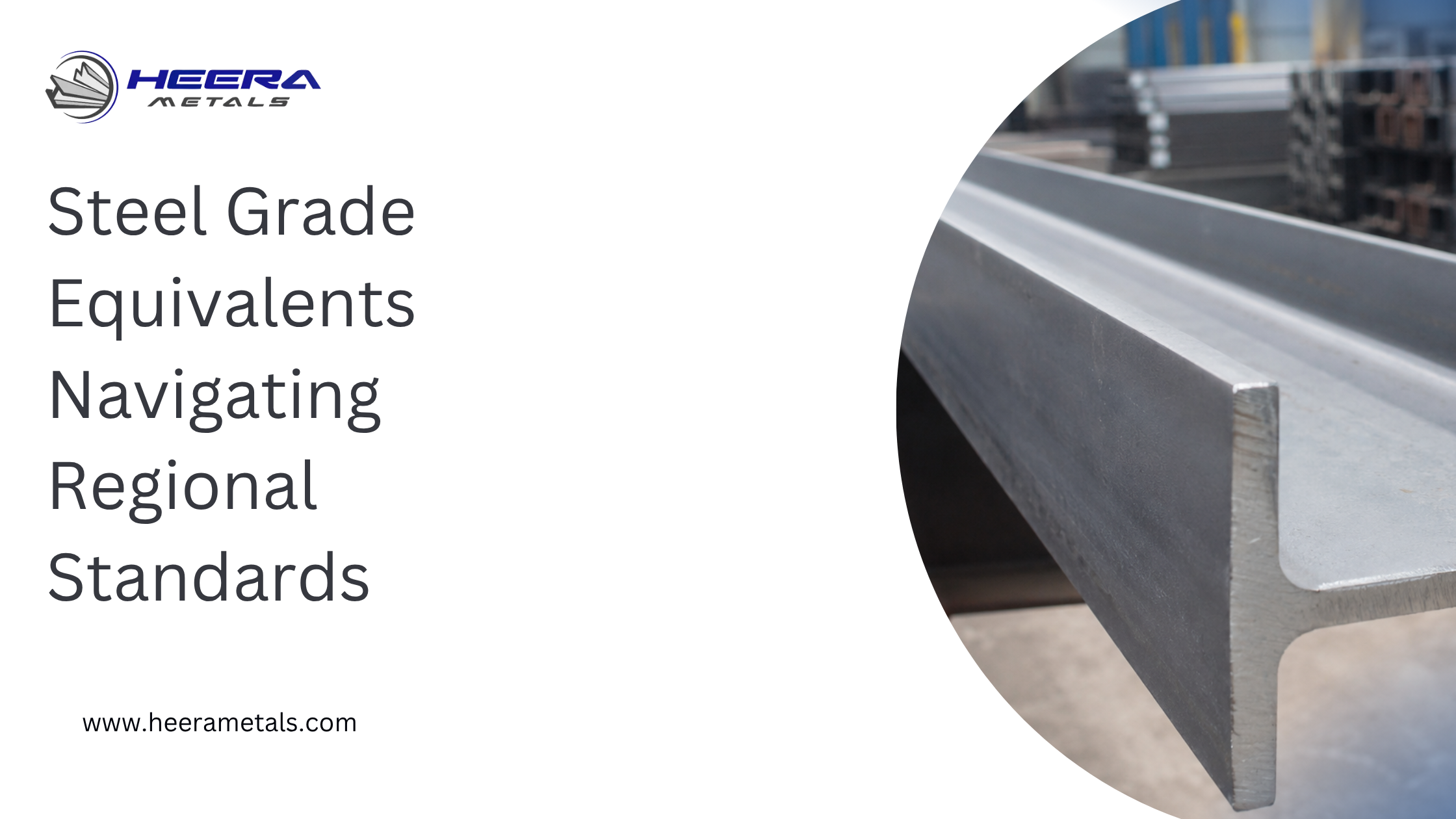
A Guide to Steel Grade Equivalents Navigating Regional Standards for Global Projects
In the modern industrial era, steel is the skeletal framework of global progress. From the soaring skyscrapers of Dubai and the high-tech infrastructure of Singapore to the massive industrial zones in Riyadh and Vietnam, steel is the universal material of choice. However, while the material is universal, the technical “language” used to describe it—its standards and grades varies significantly across borders.
For procurement managers, structural engineers, and project leads, the challenge of sourcing steel internationally lies in understanding Steel Grade Equivalents. A specification written for a refinery in Jeddah might demand ASTM A36, while a fabrication shop in Malaysia might be accustomed to JIS SS400.
The Landscape of Global Steel Standards
Steel standards are not arbitrary; they are rigorous frameworks developed by national and international organizations to ensure safety, durability, and performance. According to the World Steel Association, there are over 3,500 different grades of steel currently in use, each defined by its chemical composition and mechanical properties.
Primary Global Standardizing Bodies
To source effectively, one must understand the four primary bodies that dictate global trade:
- ASTM International: Formerly known as the American Society for Testing and Materials, these standards are the most recognized globally, particularly dominant in the Middle East (UAE, Saudi Arabia) and the Oil & Gas sector.
- JSA – Japanese Industrial Standards (JIS): These are the benchmark for South East Asia (Thailand, Vietnam, Indonesia), where Japanese engineering influence remains a cornerstone of industrial development.
- CEN – European Norms (EN): Used extensively in Singapore, Malaysia, and infrastructure projects involving European consultants.
- BIS – Bureau of Indian Standards (IS): As a leading manufacturer, Heera Metals utilizes Indian Standards (specifically IS 2062), which are meticulously aligned with international benchmarks to ensure export readiness.
Middle East Steel Requirements: Focus on UAE and Saudi Arabia
The Middle East is currently home to some of the world’s most ambitious construction projects. Driven by Saudi Vision 2030 and the UAE’s focus on becoming a global logistics hub, the demand for high-quality structural steel has never been higher.
The Dominance of ASTM in Riyadh and Jeddah
In the industrial heartlands of Riyadh and the port city of Jeddah, the ASTM A36 specification is the “gold standard” for mild steel plates and shapes. If you are importing from India, the primary equivalent is IS 2062 E250 (Grade A).
Why IS 2062 E250 is the Preferred Substitute
Both ASTM A36 and IS 2062 E250 offer a minimum yield strength of approximately 250 MPa. They share similar carbon equivalent values, ensuring that the weldability required for massive steel structures in Dubai or Abu Dhabi remains consistent regardless of the material’s origin.
Navigating SASO and SABIC Compliance
When exporting to Saudi Arabia, materials must often comply with the SASO (Saudi Standards, Metrology and Quality Organization). Furthermore, projects involving SABIC or Aramco require specific grade testing that goes beyond standard commercial steel. At Heera Metals, we ensure that our high-tensile plates (equivalent to ASTM A572 Grade 50) meet the rigorous impact testing required for the harsh temperature fluctuations of the Arabian Peninsula.
South East Asian Market: Singapore, Malaysia, and Vietnam
South East Asia is a melting pot of industrial standards. While Singapore often follows European or British standards, Vietnam, Thailand, and Indonesia lean heavily toward Japanese (JIS) specifications due to long-standing trade relationships.
Singapore’s Regulatory Rigor and BCA Standards
The Singapore Building and Construction Authority (BCA) maintains some of the world’s strictest oversight on the quality of imported steel. For structural beams where an EN 10025 S235JR grade is requested, Heera Metals provides IS 2062 equivalents that have undergone third-party verification to satisfy Singaporean structural safety codes (SS EN 1993).
The Role of JIS Standards in Vietnam and Malaysia
In the rapidly growing manufacturing hubs of Ho Chi Minh City and the Klang Valley in Malaysia, JIS G3101 SS400 is the most common requirement. This grade is contextually equivalent to India’s IS 2062 E250.
Automotive and Manufacturing Sector Equivalents
For the automotive sectors in Thailand or the electronics manufacturing plants in Vietnam, where JIS G3141 (Cold Rolled) sheets are specified, Indian IS 513 provides an ideal mechanical match, offering the ductility and surface finish required for precision engineering.
Technical Comparison: Indian (IS) vs. International Grades
To understand equivalents, one must look at the Chemical Composition (Carbon, Manganese, Silicon) and Mechanical Properties (Yield Strength, Tensile Strength). Data from the SteelNumber International Database confirms the high correlation between these global grades.
| Region | Standard Body | Grade | Yield Strength (min) | Tensile Strength |
| India | BIS | IS 2062 E250 | 250 MPa | 410 MPa |
| USA / Middle East | ASTM | A36 | 250 MPa | 400-550 MPa |
| Europe / Singapore | EN | S235JR | 235 MPa | 360-510 MPa |
| Japan / SE Asia | JIS | SS400 | 245 MPa | 400-510 MPa |
Stainless Steel for Marine and Oil & Gas Applications
For the offshore Oil & Gas sectors in Abu Dhabi or the shipyards of Indonesia, corrosion resistance is the priority.
- Grade 304: Indian IS 1570 is the direct equivalent of ASTM Grade 304 and JIS SUS304.
- Grade 316: For the highly saline environments of Jebel Ali or Singapore, Grade 316 (IS 1570 / ASTM A240) is the preferred choice due to its molybdenum content, which prevents chloride-induced pitting.
Common Pitfalls in Steel Procurement
Sourcing by “name” alone can lead to project delays, customs rejections, or even structural failures. Here are the critical factors every procurement officer in the Middle East and South East Asia must consider:
Chemical Tolerances and Weldability
Even if two grades are “equivalent,” their carbon ranges may differ. A higher carbon content can make the steel harder and more brittle, complicating the welding process on-site in a high-rise project in Manila or Bangkok. Always check the Mill Test Certificate (MTC) for the Carbon Equivalent (CE) value.
Dimensional Standards: ISMB vs. UB vs. W-Shapes
This is where many projects face hurdles. An Indian Standard Medium Beam (ISMB) has different dimensions and weight per meter than a European Universal Beam (UB) or an American Wide Flange (W-Shape). When substituting grades, engineers must ensure the section modulus of the Indian profile matches the original design intended for the Middle Eastern or ASEAN market.
Your Partner for Certified Global Exports
At Heera Metals, we don’t just supply steel; we supply certainty. Our export process for the Middle East and South East Asia is built on transparency and technical accuracy.
Quality Assurance and Mill Test Certificates (MTC)
Every shipment we dispatch to Jeddah, Singapore, or Jakarta is accompanied by a comprehensive MTC in accordance with EN 10204 3.1. This ensures full traceability from the raw material melt to the finished product delivered to your site.
Logistics Expertise for Middle East and ASEAN Ports
We understand the logistical nuances of international trade. We offer competitive freight options to:
- Port Jebel Ali (UAE): Fast-track clearance for Dubai-based contractors.
- Port of Dammam & Jeddah (KSA): Full compliance with Saudi customs and SASO requirements.
- Port of Singapore & Port Klang (Malaysia): Efficient shipping routes to support the bustling SE Asian construction market.
Bridging the Standards Gap
Understanding steel grade equivalents is the key to unlocking the high-quality, cost-competitive manufacturing power of India. By recognizing that IS 2062 can serve as a robust equivalent to ASTM A36 or JIS SS400, procurement teams can optimize their budgets without compromising on the safety or integrity of their structures.
Whether you are building a refinery in Riyadh, a high-rise in Dubai, or a manufacturing plant in Vietnam, Heera Metals is your technical partner. We translate your regional requirements into high-performance steel products, delivered on time and fully certified.


Leave a Reply