
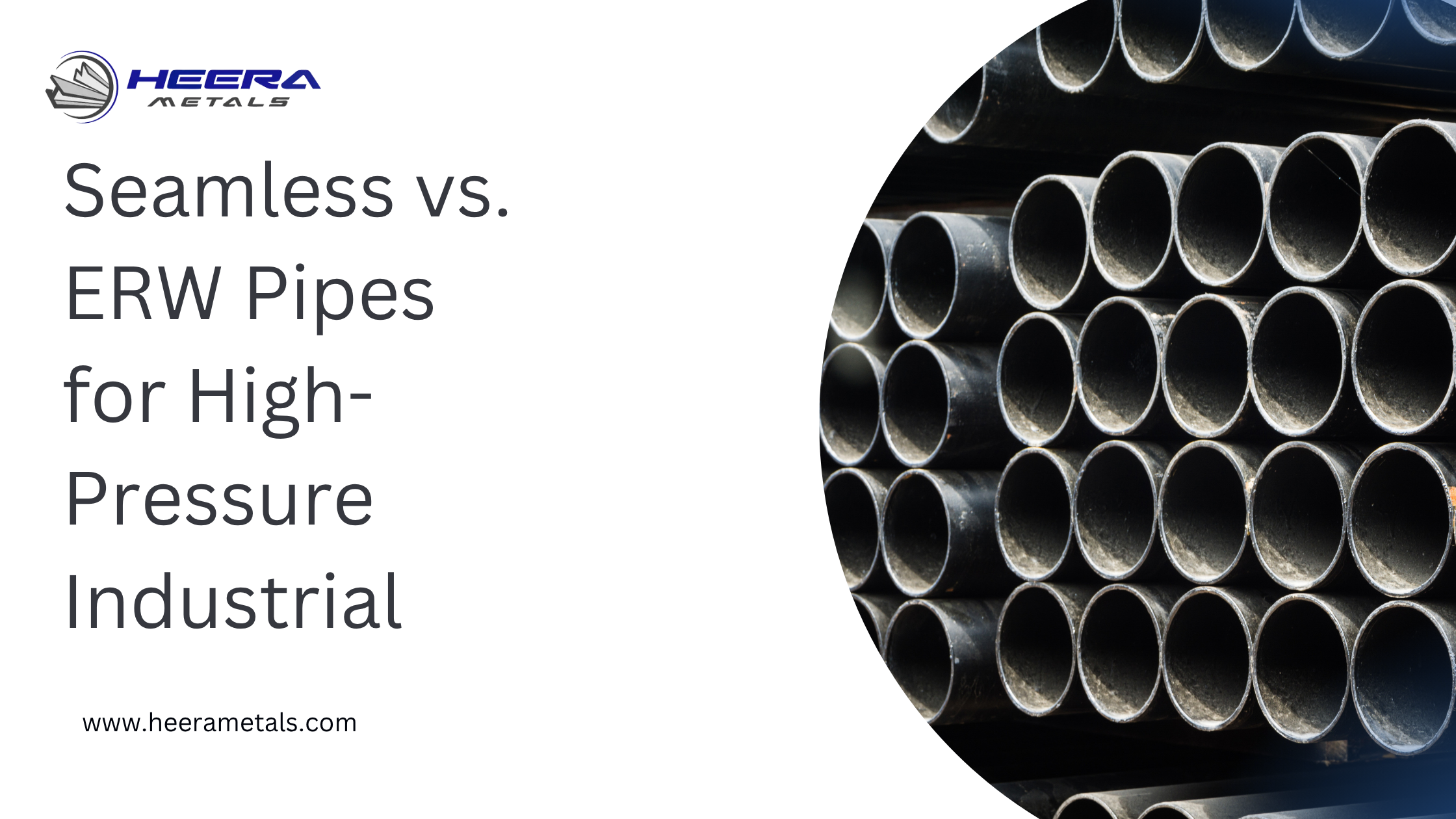
Seamless vs. ERW Pipes: Which is Better for High-Pressure Industrial Applications?
When specifying pipes for high-pressure systems oil & gas pipelines, power plant boilers, hydraulic lines, or chemical reactors the choice between Seamless and ERW (Electric Resistance Welded) pipe is one of the most consequential decisions an engineer can make. A wrong choice can mean catastrophic failure, costly downtime, or non-compliance with regulatory standards.
Both seamless and ERW pipes are widely used across heavy industries worldwide. They are made from the same grades of steel A106, A53, API 5L, and others yet their manufacturing processes produce pipes with fundamentally different mechanical characteristics, pressure ratings, and cost profiles.
This guide gives you a thorough, side-by-side analysis so you can make an informed, defensible decision for your specific application whether you’re sourcing material for UAE construction projects, Saudi Aramco-compliant pipelines, or industrial plants across the GCC.
Key Stats at a Glance:
- Seamless pipe costs 20–30% more than ERW on average
- Seamless pipe typical pressure rating: 10,000+ psi
- Most common ERW diameter range: 4″ to 24″
1. How Each Pipe is Manufactured
Understanding the manufacturing process is the foundation for understanding every performance difference that follows. The weld seam or lack thereof is the single most important structural variable.
Seamless Pipe No Weld, No Weakness
Seamless pipe is produced from a solid steel billet that is pierced and then elongated to form a hollow tube. There is no weld joint anywhere in the pipe. The result is a pipe with uniform grain structure and consistent mechanical properties throughout its cross-section.
Step 1 Billet Selection & Heating
A solid round steel billet is heated to approximately 1,200–1,300°C in a rotary hearth furnace.
Step 2 Piercing (Mannesmann Process)
The hot billet is pierced through the center using a rotating mandrel, forming a rough hollow shell called the “bloom.”
Step 3 Rolling & Elongation
The shell passes through plug mills or continuous mandrel rolling mills to achieve the desired wall thickness and diameter.
Step 4 Sizing & Finishing
The pipe is sized to final dimensions, straightened, heat-treated if required, and subjected to hydrostatic and NDT testing.
ERW Pipe Efficiency Through Electric Welding
ERW pipe is manufactured by cold-forming a flat steel strip (skelp) into a cylindrical shape and then welding the two longitudinal edges together using high-frequency electric resistance welding without filler metal. The quality of this weld seam is critical and must be carefully inspected.
Step 1 Skelp (Coil) Preparation
Hot-rolled steel coil of specified width and thickness is fed from a de-coiler into the forming section.
Step 2 Roll Forming
The flat strip is progressively shaped into a cylindrical tube using a series of forming rolls no heat is applied at this stage.
Step 3 High-Frequency Electric Resistance Welding
The two edges are forced together under pressure while high-frequency current (typically 400–450 kHz) generates intense heat, forging the edges into a solid-state weld without filler metal.
Step 4 Weld Seam Inspection & Sizing
The weld is ultrasonically or radiographically inspected, the OD flash is scarfed, and the pipe is sized, straightened, and hydrotested.
Key Insight: Modern high-frequency ERW technology has significantly improved weld seam quality compared to older low-frequency welded pipes. However, the seam remains a potential stress concentration point that seamless pipe simply does not have.
2. Head-to-Head Technical Comparison
Below is a structured breakdown of how seamless and ERW pipes compare across the parameters that matter most for high-pressure and critical industrial applications.
Structural Integrity
Seamless pipe has uniform integrity with no weld seam anywhere in its structure. ERW pipe has a longitudinal weld seam that is the primary structural variable. Advantage: Seamless.
Pressure Rating
Seamless pipe carries a higher allowable pressure for the same wall thickness. ERW pipe has a lower rating because the seam efficiency factor applies in design calculations. Advantage: Seamless.
Dimensional Tolerance
Seamless pipe typically has a wall thickness tolerance of ±12.5%. ERW pipe achieves tighter tolerances of ±5–8% because it is formed from flat-rolled coil. Advantage: ERW.
Cost
Seamless pipe carries a 20–30% price premium over ERW. ERW offers a lower baseline material cost. Advantage: ERW.
Lead Time and Availability
Seamless pipe generally has longer lead times and more limited stock. ERW pipe is readily available across a wide range of sizes. Advantage: ERW.
Cyclic and Fatigue Load
Seamless pipe performs excellently under repeated pressure cycling. ERW pipe performs well but the weld seam can be a fatigue initiation point under severe cyclic conditions. Advantage: Seamless.
Temperature Range
Seamless pipe is rated for a wider range, covering both very high and cryogenic low temperatures. ERW pipe is suited to a moderate temperature range. Advantage: Seamless.
Corrosion and Sour Service
Seamless pipe is the preferred choice for NACE and H₂S environments. ERW pipe is acceptable with post-weld heat treatment (PWHT) but requires more scrutiny. Advantage: Seamless.
Surface Finish
Seamless pipe has a moderate internal and external finish. ERW pipe has a better surface finish due to the cold-rolling of the source skelp. Advantage: ERW.
Large Diameter Availability
Seamless pipe has limited availability above 24 inches in diameter. ERW and LSAW pipe are widely available in large diameters for transmission pipelines. Advantage: ERW / LSAW.
3. Performance Under High Pressure The Critical Factor
For high-pressure applications, the design equation for pipe wall thickness based on ASME B31.3 or ASME B31.1 includes a joint efficiency factor (E). This factor directly penalizes welded pipe when compared to seamless.
Design Code Implication: Under ASME B31.3, seamless pipe carries a joint efficiency factor of E = 1.00, while ERW pipe is assigned E = 0.85 or lower for older welded types. This means for identical materials, ERW pipe must have a proportionally thicker wall to achieve the same allowable pressure increasing both cost and weight.
Barlow’s Formula Understanding the Pressure Difference
P = (2 × S × E × t) / OD
Where P = internal design pressure, S = allowable stress, E = joint efficiency, t = wall thickness, and OD = outside diameter.
When E = 0.85 (ERW) versus E = 1.00 (Seamless), the ERW pipe can only sustain 85% of the allowable pressure for the same wall thickness. In practical terms, either the wall must be made thicker, or the application must be derated. For high-pressure systems, this makes seamless the engineering default.
Fatigue and Cyclic Loading
In applications where pressure cycles repeatedly such as reciprocating compressors, hydraulic systems, or pulsating flow lines the weld seam in ERW pipe introduces a stress concentration that can become a fatigue crack initiation site over time. Seamless pipe, with its homogeneous structure, is significantly more resistant to fatigue failure under cyclic conditions.
Sour Service and H₂S Environments
For pipelines carrying wet H₂S or CO₂, Sulfide Stress Cracking (SSC) is a critical concern. Per NACE MR0175 / ISO 15156, the weld seam and heat-affected zone (HAZ) of ERW pipe require careful hardness control and often post-weld heat treatment (PWHT). Seamless pipe, lacking a weld, avoids this compliance burden entirely.
Industry Consensus: For pressure ratings above 1,500 psi, elevated temperatures above 400°C, sour service environments, or any piping classified as Class 150 or higher per ASME standards, seamless pipe is the universally preferred choice among experienced piping engineers.
4. Industry Applications Where Each Pipe Type Excels
The right choice is always application-driven. Below are the primary industry segments and the pipe type best suited to each.
4.1 Best Applications for Seamless Pipe
Oil & Gas Exploration
Downhole tubing, casing, and drilling applications demand seamless pipe per API 5CT and API 5L standards. Subsurface pressures and corrosive formation fluids make seamless the only acceptable choice.
Power Generation
High-pressure boiler tubes and superheater lines operate at extreme temperatures and pressures. Seamless pipe is required by ASME Section I for boiler construction.
Chemical and Petrochemical Plants
Reactor piping, high-pressure heat exchangers, and sour service lines in refineries and chemical plants require seamless pipe where weld seam integrity is directly tied to personnel and process safety.
Hydraulic Systems
High-pressure hydraulic cylinders and lines operating at 5,000–10,000 psi with constant cyclic loading are among the most demanding applications for seamless pipe.
Best Applications for ERW Pipe
Structural and Construction
Building frames, scaffolding, hollow structural sections (HSS), and columns across UAE and GCC construction projects where pressure rating is not the governing design criterion.
Water and Irrigation Systems
Municipal water supply networks, irrigation pipelines, and sewage lines operating at low to moderate pressures are a primary and highly suitable market for ERW pipe.
City Gas Distribution
Low-pressure natural gas distribution networks within urban and industrial areas, supplied per IS 3589, ASTM A53, or equivalent standards.
HVAC and MEP Services
Chilled water lines, fire suppression systems, and air handling units in commercial buildings ERW pipe delivers excellent value at the moderate pressures these systems demand.
5. Cost Analysis True Total Cost of Ownership
On a per-tonne or per-meter basis, ERW pipe is consistently cheaper than seamless pipe in the same grade and schedule. However, a responsible procurement decision must look beyond the initial purchase price.
Direct Cost Factors
Material purchase price Seamless carries a 20–30% premium. ERW is the lower-cost baseline.
Wall thickness required Seamless allows a thinner wall for the same design pressure. ERW must compensate for its lower joint efficiency (E = 0.85), which often increases the required schedule and therefore the material weight.
Inspection and testing cost Seamless requires standard hydrostatic testing plus NDE. ERW requires additional seam-specific inspection methods such as ultrasonic seam scanning.
PWHT requirements In sour service, ERW pipe often requires mandatory post-weld heat treatment. Seamless pipe typically does not, reducing fabrication cost and schedule.
Indirect and Lifecycle Cost Factors
Failure and replacement risk ERW pipe in critical service carries a higher risk of seam-related failure. A single unplanned shutdown in an oil refinery or power plant can cost far more than the entire material savings achieved by specifying ERW.
Insurance and liability premiums For Class 300 and higher pressure service, specifying ERW over seamless may attract higher insurance premiums or require additional engineering justification.
Procurement Advisory: For a low-pressure structural application, ERW over seamless yields a genuine 20–25% material cost saving with no engineering downside. For a high-pressure process line in a refinery or gas plant, the cost of a single failure in downtime, environmental liability, and human safety will dwarf any savings made at procurement. In critical service, seamless is always the more economical choice over the full project lifecycle.
6. International Standards and Certifications
Compliance with recognized international standards is mandatory for export, project approval, and insurance especially for steel supplied to the Gulf region, where Saudi Aramco, ADNOC, and major EPC contractors enforce strict material traceability requirements.
Key Standards Reference
ASTM A106 Grade B/C Seamless High-temperature service: boilers, refineries, steam lines.
ASTM A53 Grade A/B Seamless & ERW General purpose water and gas distribution.
API 5L PSL 1 & PSL 2 Seamless & ERW Oil and gas pipelines. Seamless is preferred for PSL 2 critical service.
API 5CT Seamless only Casing and tubing for oil and gas wells.
ASME B36.10M Both Dimensions standard for wrought steel pipe.
EN 10216-2 Seamless European standard for seamless tubes for pressure purposes.
IS 1978 / IS 3589 ERW Indian standard for ERW steel pipes for water and gas service.
SASO / SABER (Saudi Arabia) Both Mandatory Saudi certification required for import and sale in KSA.
Middle East Compliance Note
Exporters supplying steel pipes to Saudi Arabia must comply with SASO (Saudi Standards, Metrology and Quality Organization) requirements. Products require SABER certification before customs clearance at any Saudi port. Seamless pipes for hydrocarbon service must additionally comply with Saudi Aramco’s SAES engineering standards. Always confirm the current applicable standards with your end client before shipment to avoid costly delays or rejection at the port.
7. Final Verdict Which Pipe Should You Choose?
There is no single universal answer. The right pipe depends on your design pressure, operating temperature, fluid chemistry, regulatory environment, and project economics. However, the engineering rule of thumb is clear and consistent across industry practice.
Use seamless pipe when performance is non-negotiable high pressure, elevated temperature, sour service, cyclic loading, or any application where the consequence of failure is severe.
Use ERW pipe when economy matters and the design conditions permit structural applications, low-to-medium pressure fluid service, water systems, and general construction where the weld seam presents no meaningful risk.


Leave a Reply