
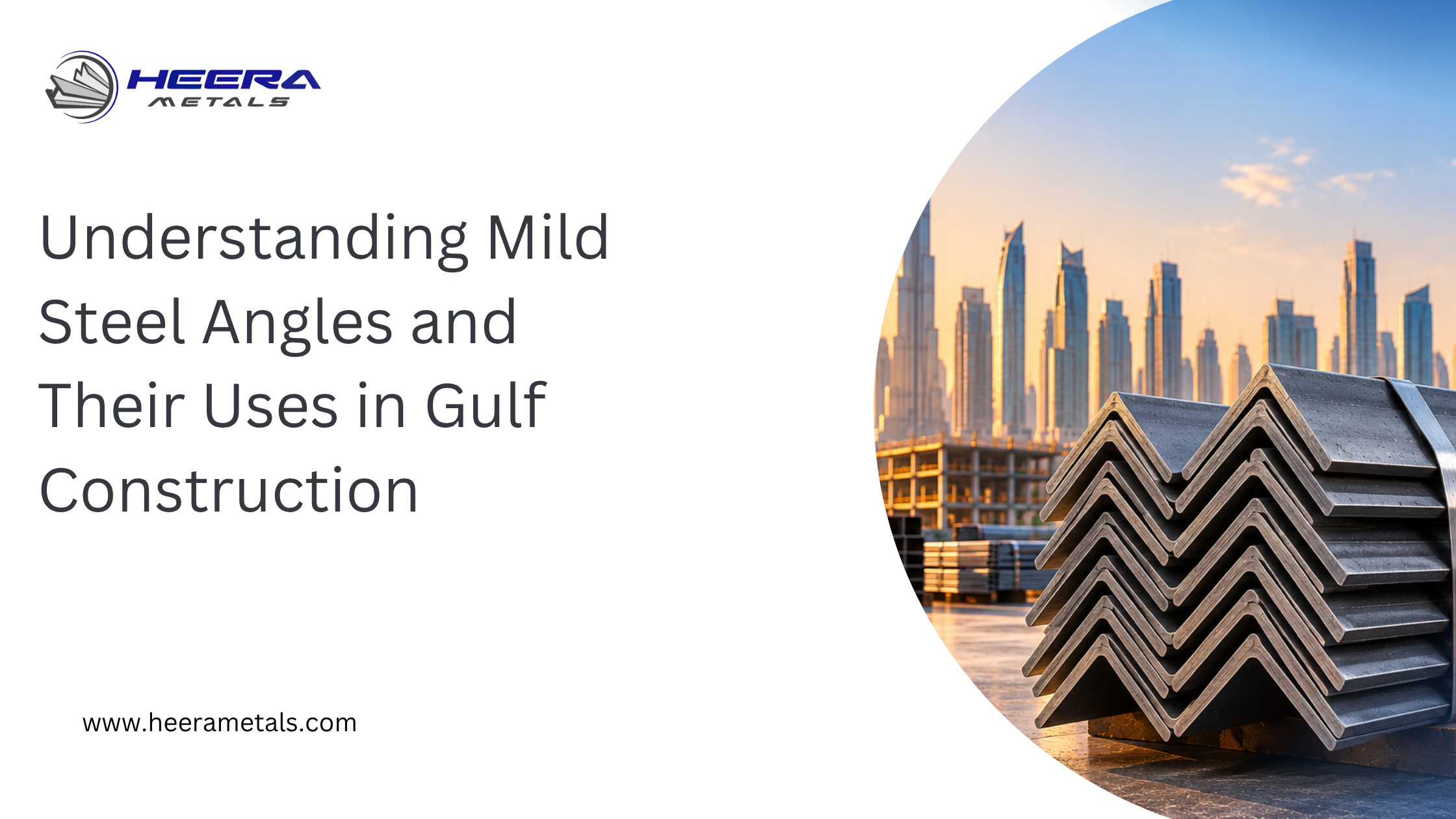
Understanding Mild Steel Angles and Their Uses in Gulf Construction
Mild steel angles, also called MS angles, are L-shaped structural sections used to frame, brace, and support buildings and industrial structures. In Gulf construction they appear in warehouses, factories, transmission towers, mezzanines, and building frameworks across the UAE and Saudi Arabia, because they are strong, easy to fabricate, and cost-effective in bulk. Choosing the right angle depends on its type (equal or unequal), size, grade, and surface protection, and on whether the supplier can document quality.
what MS angles are, where they are used in Gulf projects, how to specify them, and what to check when sourcing from an MS angle supplier in the UAE, Saudi Arabia, or from an Indian exporter.
What Are Mild Steel Angles?
A mild steel angle is a hot-rolled steel section with two legs meeting at a right angle, forming an “L” shape. “Mild steel” refers to low-carbon steel that is strong enough for structural work while remaining easy to cut, drill, bend, and weld.
In India, structural angles are typically produced from steel conforming to IS 2062, the Indian Standard for hot-rolled medium and high tensile structural steel. The common E250 grade has a minimum yield strength of 250 MPa for thicknesses up to 20 mm, a minimum tensile strength of 410 MPa, and a minimum elongation of 23% . Dimensions and tolerances for the sections themselves are usually governed by IS 808 and IS 1852.
Equal and Unequal Mild Steel Angles
The two main types differ in leg length:
- Equal angles have legs of the same length (for example, 50 × 50 mm). They are the most widely used type for bracing, frames, and general fabrication.
- Unequal angles have legs of different lengths (for example, 75 × 50 mm). They suit connections where one leg needs a larger bearing or fixing surface, such as lintels and certain trusses.
Both types are specified by leg length and thickness, for example 75 × 75 × 6 mm.
Common Sizes and Weights
Angle sizes range from small sections used in light fabrication to heavy sections for primary structural members. The table below shows approximate unit weights for three commonly requested equal angles. Always confirm exact figures against the relevant standard table or the mill’s data sheet, as weight depends on rolling tolerances.
| Equal angle (mm) | Typical use | Approx. weight (kg/m) |
| 50 × 50 × 5 | Light bracing, racks, supports | 3.8 |
| 75 × 75 × 6 | Trusses, purlin cleats, platforms | 6.8 |
| 100 × 100 × 10 | Heavier frames, towers, industrial supports | 14.9 |
Where Are MS Angles Used in Gulf Construction?
MS angles are used wherever a structure needs economical bracing, edge framing, or secondary support. The Gulf’s mix of industrial development, logistics growth, and large infrastructure programmes keeps these applications active.
Warehouses, Factories, and Industrial Buildings
Pre-engineered and conventional steel buildings use angles for bracing, roof trusses, purlin supports, and wall framing. Logistics parks and industrial zones in the UAE and Saudi Arabia are a steady source of this demand.
Commercial Buildings and Building Frameworks
In commercial construction, angles form lintels, mezzanine frames, staircase supports, edge trims for slabs, and secondary framing around openings and services.
Infrastructure and Utility Projects
Angle sections are widely used in transmission and telecom towers, cable trays and supports, pipe racks, and substation structures. Power, water, and rail programmes across the Gulf rely on these lighter structural sections alongside beams and plates.
Fabrication and Engineering Work
Fabrication shops use angles for machine bases, equipment frames, platforms, ladders, and handrail posts. Their uniform shape makes cutting and welding predictable and repeatable.
Why Gulf Demand for Structural Steel Angles Remains Strong
Demand is tied to the volume of construction and industrial activity in the region, particularly in the UAE and Saudi Arabia.
- Saudi Arabia: The kingdom’s Deputy Minister of Industry and Mineral Resources has said construction mega-projects launched in recent years are worth more than 5 trillion riyals (about USD 1.33 trillion), most of them still in development. A consultancy analysis projected finished iron and steel demand in Saudi Arabia to grow at a 3.9% CAGR from 2023 to 2026..
- UAE: The national industrial strategy, Operation 300bn, aims to lift the industrial sector’s GDP contribution from AED 133 billion to AED 300 billion by 2031 . More factories and warehouses mean more structural framing.
- UAE supply base: Emirates Steel, the largest domestic producer, reported 3.25 million tons of crude steel in 2024. Domestic output is led by products such as rebar, so many buyers still import sections such as angles and channels to meet specific size and grade needs.
Market-research figures vary between publishers, so treat forecasts as indicators and verify them against your own project pipeline.
How to Choose the Right Mild Steel Angle for a Project
Start with the structural requirement, then work through grade, size, protection, and documentation.
- Confirm the design requirement. Take the section size, thickness, and grade from the structural drawings and engineer’s specification.
- Select the grade. E250 is common for general construction. Higher-strength grades such as E350 are used where loads or weight savings justify them. Where welded or low-temperature service is involved, the engineer may specify a quality subgrade with impact testing.
- Check the thickness. Guaranteed yield strength drops as thickness increases, so design values should match the actual section thickness.
- Specify surface protection. Gulf coastal humidity, salt exposure, and heat make corrosion protection a real design point (see below).
- Define length and tolerances. Specify cut lengths, straightness, and delivery length to reduce on-site wastage.
- Require documentation. Ask for mill test certificates showing chemical composition and mechanical properties for each heat or batch.
Surface Protection for Gulf Conditions
Plain mild steel corrodes in humid, saline coastal air. Common protection options include:
- Hot-dip galvanizing for long-term protection of towers, outdoor frames, and coastal structures.
- Primer and paint systems for building frames, applied after fabrication.
- Shop-applied coatings specified by the consultant for particularly aggressive environments.
The right choice depends on the exposure class and the design life stated in the project specification.
Mild Steel Angles vs Other Structural Sections
Angles are one of several structural shapes. The right choice depends on the load path.
| Section | Best suited for |
| Angles (L-sections) | Bracing, trusses, towers, secondary framing, supports |
| Channels (C-sections) | Purlins, girts, beam-to-beam connections, frames |
| Beams (I and H sections) | Primary load-bearing members and long spans |
| Plates | Base plates, gussets, heavy fabrication, tanks |
Sourcing MS Angles From India for Gulf Projects
India is a major producer of structural sections, and Indian mild steel angles are commonly supplied to UAE and Saudi buyers. Proximity, wide size availability, and competitive bulk pricing are the main reasons.
What to Look for in an MS Angle Manufacturer or Exporter in India
- Standards compliance: Production to IS 2062 or an equivalent specification accepted on the project, with sizes to IS 808.
- Certification and traceability: Mill test certificates linked to heat or batch numbers, plus third-party inspection when the project requires it.
- Size range and stock: Ability to supply the full range of equal and unequal angles, in the lengths the project needs.
- Export packing: Bundling and protection suitable for sea freight, with clear marking for identification at port and site.
- Delivery reliability: Consistent lead times and the ability to ship phased consignments for large contractors.
What to Confirm for the UAE and Saudi Arabia
Check that the specification is accepted by the project consultant, whether the destination country requires any product conformity or registration for steel sections, and what customs duties apply. Rules differ between the UAE and Saudi Arabia and can change, so confirm current requirements with your supplier or customs agent before ordering.
Bulk Procurement Tips
- Consolidate size and grade requirements across packages to improve volume pricing.
- Add a cutting and wastage allowance to quantities.
- Compare quotations on identical specification, delivery terms, and price validity.
- Plan port clearance and inland transport before shipment.
- Agree on inspection and documentation requirements in the purchase order.
Frequently Asked Questions
What is a mild steel angle used for?
It is used for bracing, framing, supports, trusses, towers, and general fabrication in buildings, industrial structures, and infrastructure.
What is the difference between equal and unequal MS angles?
Equal angles have legs of the same length, while unequal angles have legs of different lengths. Equal angles are more common for general structural work.
Which grade of MS angle is commonly used in construction?
IS 2062 E250 is widely used for general structural work, with a minimum yield strength of 250 MPa for thicknesses up to 20 mm.
Do MS angles need protection in the UAE and Saudi Arabia?
Yes, in most cases. Humidity, salt, and heat accelerate corrosion, so galvanizing or a suitable paint system is usually specified.
Can I import MS angles from India to the UAE or Saudi Arabia?
Yes. India is a major source of structural sections. Confirm the specification, certification, duties, and any conformity requirements for the destination country before ordering.
How do I choose an MS angle supplier?
Look for a supplier who provides mill test certificates, offers the sizes and grades you need, packs for export, and delivers on schedule.
What documents should come with an MS angle shipment?
Typically a mill test certificate, packing list, commercial invoice, and any third-party inspection report required by the project.
Conclusion
Mild steel angles remain a basic building block of Gulf construction, supporting everything from warehouse frames and transmission towers to commercial building supports. The right choice comes down to type, size, grade, corrosion protection, and documented quality, backed by a supplier who can deliver consistently.
For contractors and buyers sourcing structural steel angles for UAE and Saudi projects, a short specification and quantity list is usually enough to get a comparable quotation. You can share your requirements with Heera Metals to discuss available sizes, grades, and export supply from India.


Leave a Reply