
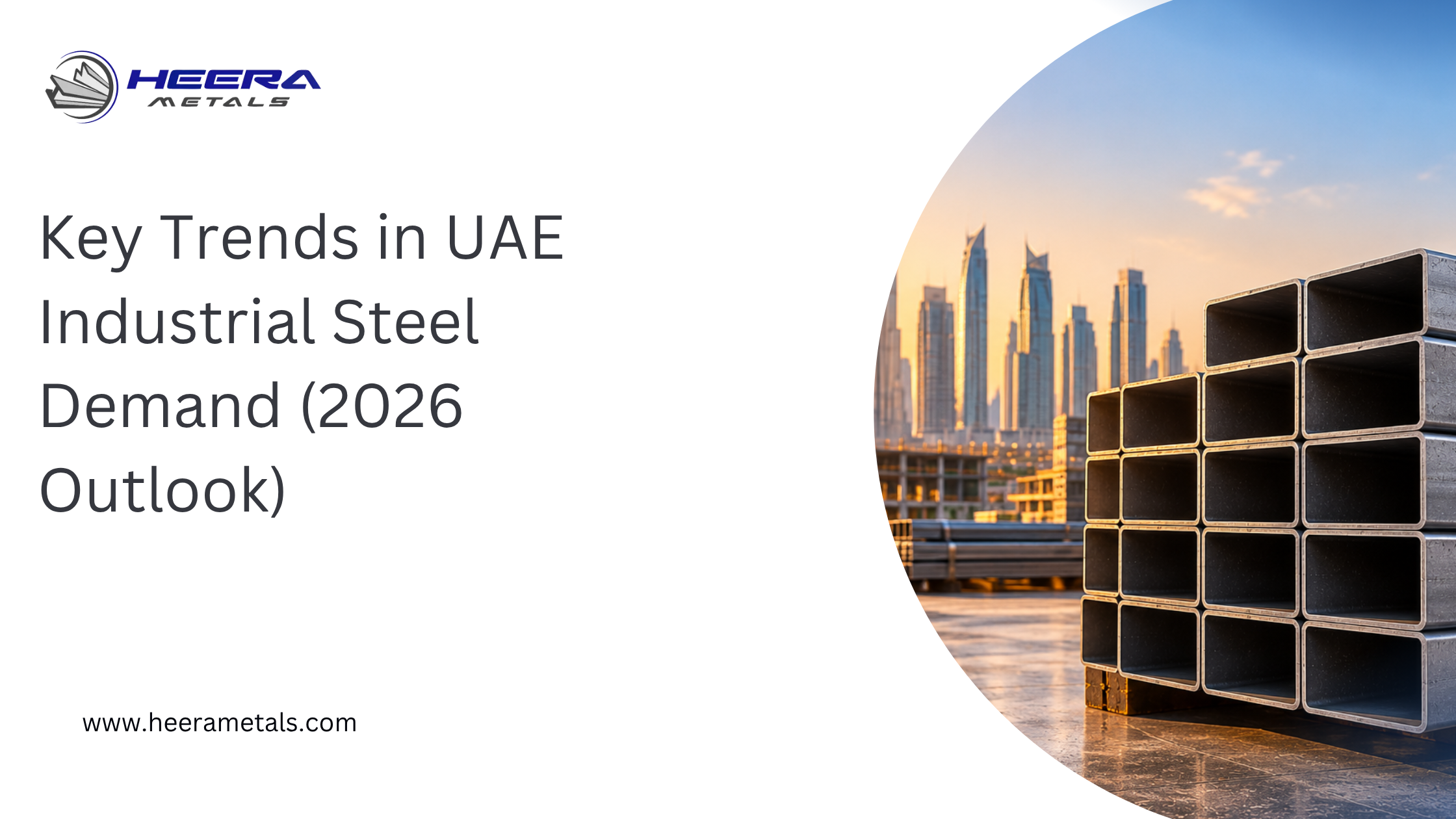
Key Trends in UAE Industrial Steel Demand (2026 Outlook)
UAE industrial steel demand in 2026 is being shaped by three forces: a deep pipeline of infrastructure and real estate projects, a deliberate push to expand domestic manufacturing, and ongoing investment in energy and logistics. Together, these keep demand for structural sections, plates, coils, and reinforcement steady across Dubai, Abu Dhabi, and the Northern Emirates. At the same time, buyers are paying closer attention to quality certification, delivery reliability, and price volatility.
what is driving steel consumption in the UAE, which sectors and products matter most, how sourcing from India fits into the supply chain, and what procurement teams should plan for in 2026.
What Is Driving UAE Industrial Steel Demand in 2026?
The main drivers are large-scale infrastructure development, industrial diversification away from oil dependence, and sustained construction activity in commercial, residential, and logistics real estate. Steel sits underneath almost all of them, which is why UAE steel consumption tends to track the pace of capital projects rather than short-term market sentiment.
Infrastructure and Construction Pipeline
Infrastructure development remains the single largest influence on steel demand. Rail, roads, ports, airports, utilities, and urban expansion plans all require structural steel, reinforcement, and fabricated components. Projects linked to the national rail network, Dubai’s long-term urban master plan, and continued port and airport expansion keep construction steel demand active well beyond a single year.
Commercial and mixed-use developments add to this. High-rise towers, hospitality projects, and large retail and community developments consume structural steel beams, channels, and plates in volume.
Economic Diversification and Industrialization
The UAE’s economic diversification strategy places manufacturing, advanced industry, and logistics at the centre of long-term growth. Operation 300bn, the national industrial strategy, aims to raise the industrial sector’s contribution to GDP from AED 133 billion to AED 300 billion by 2031, and industrial zones in Dubai, Abu Dhabi, Sharjah, and Ras Al Khaimah continue to attract new facilities.
Every new factory, processing plant, or industrial park needs steel for its building frame, process equipment, piping supports, platforms, and material-handling systems. This is why industrialization driving steel demand in the UAE is a lasting trend rather than a temporary spike.
Energy, Oil and Gas, and Utilities
Oil and gas remain a significant source of steel demand, particularly for plates, pipes, and structural fabrication used in refineries, petrochemical facilities, storage, and offshore-linked work. Alongside this, investment in power generation, water desalination, and renewable energy adds demand for steel used in transmission structures, solar mounting systems, and utility buildings.
Warehousing and Logistics Growth
The UAE’s role as a regional trade hub drives continued construction of warehouses, distribution centres, and cold-storage facilities. These are typically pre-engineered or structural steel buildings, which makes them a steady source of demand for sections, purlins, plates, and coils.
Key Trends Shaping the UAE Steel Market in 2026
Beyond the overall demand drivers, several market-level trends are influencing how steel is bought and supplied.
Steady Demand Led by Structural and Construction Steel
Structural steel and construction-grade products continue to account for the bulk of steel demand in the UAE market. Beams, channels, angles, and plates used in buildings, industrial sheds, and infrastructure are the core of consumption, supported by reinforcement steel for concrete work.
Heavy Reliance on Imports
The UAE has established domestic steel production, but a large share of its requirement, particularly for specific grades, sizes, and finished products, is met through imports. This makes the UAE steel import market sensitive to global pricing, freight costs, trade policy, and exporting-country conditions.
Domestic mills cover a meaningful share of the requirement. Emirates Steel, the largest domestic producer, reported 3.25 million tons of crude steel in 2024, with rebar the leading finished product (Arab Iron and Steel Union). To protect local producers, the UAE applies a 10% customs duty on rebar and wire rod, up from 5%. The latest extension runs until 12 October 2026 (Arab Iron and Steel Union), so buyers should confirm its current status before pricing imported rebar.
Quality, Certification, and Traceability
Consultants and contractors on major projects increasingly expect mill test certificates, grade compliance with recognized standards, and traceable batch records. Buyers who cannot document material quality risk delays at inspection or approval stages.
Price Volatility and Cost Planning
Steel prices move with raw material costs, energy prices, freight rates, and global supply and demand. For project-based buyers, this has pushed more attention toward early procurement, framework supply arrangements, and clearer price validity terms in quotations.
Sustainability and Low-Carbon Steel Expectations
Sustainability requirements in green building frameworks, and carbon-related trade measures such as the EU’s Carbon Border Adjustment Mechanism, are making emissions an increasingly visible factor in the steel industry. While not yet a deciding factor in most local purchasing, buyers on large or internationally financed projects are asking more questions about production routes and environmental credentials.
UAE Steel Market Data at a Glance
The figures below give a factual baseline for the trends above. Market-research estimates vary by publisher, so treat them as indicators rather than exact forecasts.
| Data point | Figure | |
| Industrial sector GDP contribution target (Operation 300bn) | From AED 133 billion to AED 300 billion by 2031 | |
| Emirates Steel crude steel output, 2024 | 3.25 million tons | |
| Emirates Steel finished steel output, 2024 | 2.835 million tons, including about 1.77 million tons of rebar | |
| Customs duty on rebar and wire rod | 10% (raised from 5%), extended until 12 October 2026 | |
| Global steel demand (worldsteel forecast) | About 1,750 Mt in 2025, rising 1.3% to 1,773 Mt in 2026 | |
| Dubai’s share of UAE prefabricated and structural steel market demand | Approximately 42% |
The Emirates Steel figures cover that company’s output only, not the whole national market. The Dubai share comes from a commercial market-research report, so verify it against your own project data.
Steel Demand in Dubai and Abu Dhabi
Steel demand in Dubai and Abu Dhabi differs in character, and understanding the difference helps with planning supply.
- Dubai: Demand is closely linked to real estate, hospitality, aviation, port and free-zone activity, and logistics. Large vertical developments and warehouse construction in areas such as Jebel Ali and Dubai Industrial City are major consumers.
- Abu Dhabi: Demand leans more toward industrial, energy, and government-led infrastructure projects, including development at KEZAD, oil and gas facilities, and long-term public works.
- Northern Emirates: Sharjah, Ajman, and Ras Al Khaimah contribute through manufacturing clusters, fabrication yards, and industrial parks.
For suppliers and buyers, this means product mix and delivery timelines can vary noticeably by emirate and project type.
Which Steel Products Are in Demand for UAE Industrial Projects?
The most in-demand steel products are structural sections, plates, coils, and reinforcement materials used across construction and industrial applications. The table below summarizes common products and where they are typically used.
| Steel product | Typical applications in UAE projects |
| Structural beams (I-beams, H-beams) | Building frames, industrial sheds, bridges, equipment supports |
| Channels and MS angles | Bracing, purlins, platforms, fabrication, supports |
| Steel plates | Storage tanks, pressure vessels, heavy fabrication, base plates |
| Hot-rolled and cold-rolled coils | Roofing and cladding, pipes, sheet metal products, manufacturing |
| Reinforcement bars (TMT) | Concrete structures, foundations, slabs |
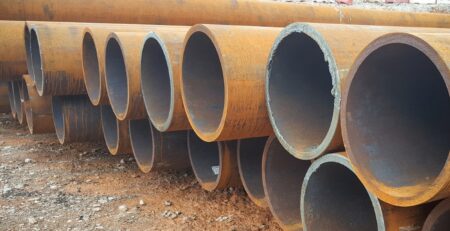
| Pipes and tubes | Structural use, fluid transfer, scaffolding, utilities |
The correct choice depends on load requirements, design codes, the project environment (coastal humidity and heat affect corrosion considerations), and the fabrication process planned.
How Indian Steel Exports Supply the UAE Market
India is one of the larger sources of steel products for the UAE, and the relationship is supported by geographic proximity, established shipping routes, and the India-UAE Comprehensive Economic Partnership Agreement (CEPA), which has strengthened bilateral trade since it took effect in 2022.
Why UAE Buyers Source Steel from India
- Product range: Indian mills and processors produce a wide range of structural sections, plates, coils, and bars.
- Shorter transit times: Shipping routes between Indian ports and UAE ports are short compared with many other sources, which helps manage project schedules.
- Competitive pricing: Scale and cost structure often make Indian-origin steel commercially attractive for bulk requirements.
- Familiar standards: Many Indian products are produced to internationally recognized specifications, which can simplify approvals when documentation is complete.
What to Verify When Sourcing from India
Buyers should confirm the exact grade and standard, mill test certificates, third-party inspection options, packaging suitable for sea freight, and clear delivery terms. Policy and regulatory conditions on both sides can change, so it is worth checking current export and import requirements before finalizing large orders.
How to Approach Industrial Steel Procurement in the UAE
A structured procurement approach reduces cost surprises and delivery risk. A practical process looks like this:
- Define the specification early. Confirm grade, dimensions, tolerances, standards, and certification requirements from the engineering drawings and consultant approvals.
- Estimate quantities with a margin. Include allowances for cutting wastage and fabrication losses.
- Request comparable quotations. Ask suppliers to quote against the same specification, quantity, delivery terms, and price validity.
- Check supplier credentials. Review documentation practices, past project supply, stock availability, and logistics capability.
- Plan logistics and lead time. Consider port clearance, inland transport, and site delivery sequencing, especially for bulk steel procurement.
- Agree on inspection and documentation. Decide in advance on mill certificates, third-party testing, and handover documents.
What to Look for in an Industrial Steel Supplier in the UAE
The best supplier for an infrastructure or industrial project is typically one that combines dependable stock or sourcing capacity, verifiable quality documentation, transparent pricing, and consistent delivery performance. Responsiveness during technical clarification and the ability to support phased deliveries are also practical differentiators, especially on large projects.
Challenges That Could Affect Steel Supply and Demand in 2026
Several risks are worth factoring into planning:
- Global price swings linked to raw material and energy costs.
- Freight and port disruptions that affect lead times and landed cost.
- Trade policy changes, including duties, safeguards, and quality control rules in exporting or importing countries.
- Project timing shifts, where delays or accelerations in large developments change demand patterns quickly.
- Specification mismatches, where material arrives but does not meet approval requirements.
Buyers who plan early, maintain more than one qualified supply source, and document specifications clearly are generally better placed to absorb these shocks.
Outlook: What Industrial Steel Demand Could Look Like in 2026 and Beyond
The broad outlook is one of continued, project-driven demand. Infrastructure, industrial expansion, energy, and logistics are all long-cycle sectors, so steel requirements are likely to remain supported through 2026 and beyond. Exact volume forecasts vary by source and should be checked against current publications from industry associations, market research firms, and government bodies before being used in business planning.
At the global level, worldsteel’s forecast points to a modest recovery in 2026, with demand rising about 1.3% to roughly 1,773 million tonnes (Arab Iron and Steel Union summary). UAE demand is more closely tied to local project timelines than to the global average.
The more useful signal for buyers is qualitative: demand is shifting toward better-documented, traceable, and increasingly sustainability-aware steel supply, with reliable delivery valued as highly as price.
Frequently Asked Questions
What is driving UAE industrial steel demand in 2026?
Infrastructure development, industrial diversification, construction activity, energy and utilities investment, and logistics and warehouse expansion are the main drivers.
Which sectors consume the most steel in the UAE?
Construction and infrastructure lead, followed by oil and gas, manufacturing, energy and utilities, and warehousing and logistics.
Does the UAE import steel?
Yes. The UAE has domestic production, but imports play a significant role in meeting demand for particular grades, sections, and finished products, with India among the notable sources.
Is steel demand different in Dubai and Abu Dhabi?
Dubai’s demand is more tied to real estate, aviation, ports, and logistics, while Abu Dhabi’s leans toward industrial, energy, and government infrastructure projects.
What steel products are most used in UAE industrial projects?
Structural beams, channels, angles, plates, coils, reinforcement bars, and pipes are the most commonly used products.
Why do UAE buyers import steel from India?
Proximity, a broad product range, competitive pricing for bulk orders, and a supportive trade framework make India a practical sourcing option.
How can buyers manage steel price volatility?
By procuring early, agreeing on defined quotation validity periods, using framework supply arrangements where suitable, and maintaining relationships with more than one qualified supplier.
Conclusion
UAE industrial steel demand in 2026 rests on solid foundations: a long infrastructure pipeline, a growing industrial base, continued energy investment, and expanding logistics capacity. Structural and construction-grade steel remain at the centre of consumption, while imports, including supply from India, play an important part in meeting requirements.
For buyers, the practical takeaway is to treat procurement as a planning exercise: define specifications clearly, verify quality documentation, build in logistics lead time, and choose a supplier that can deliver consistently. Teams looking for structural steel, plates, coils, or channels for upcoming industrial work can speak with Heera Metals about their requirements and supply options.



Leave a Reply