
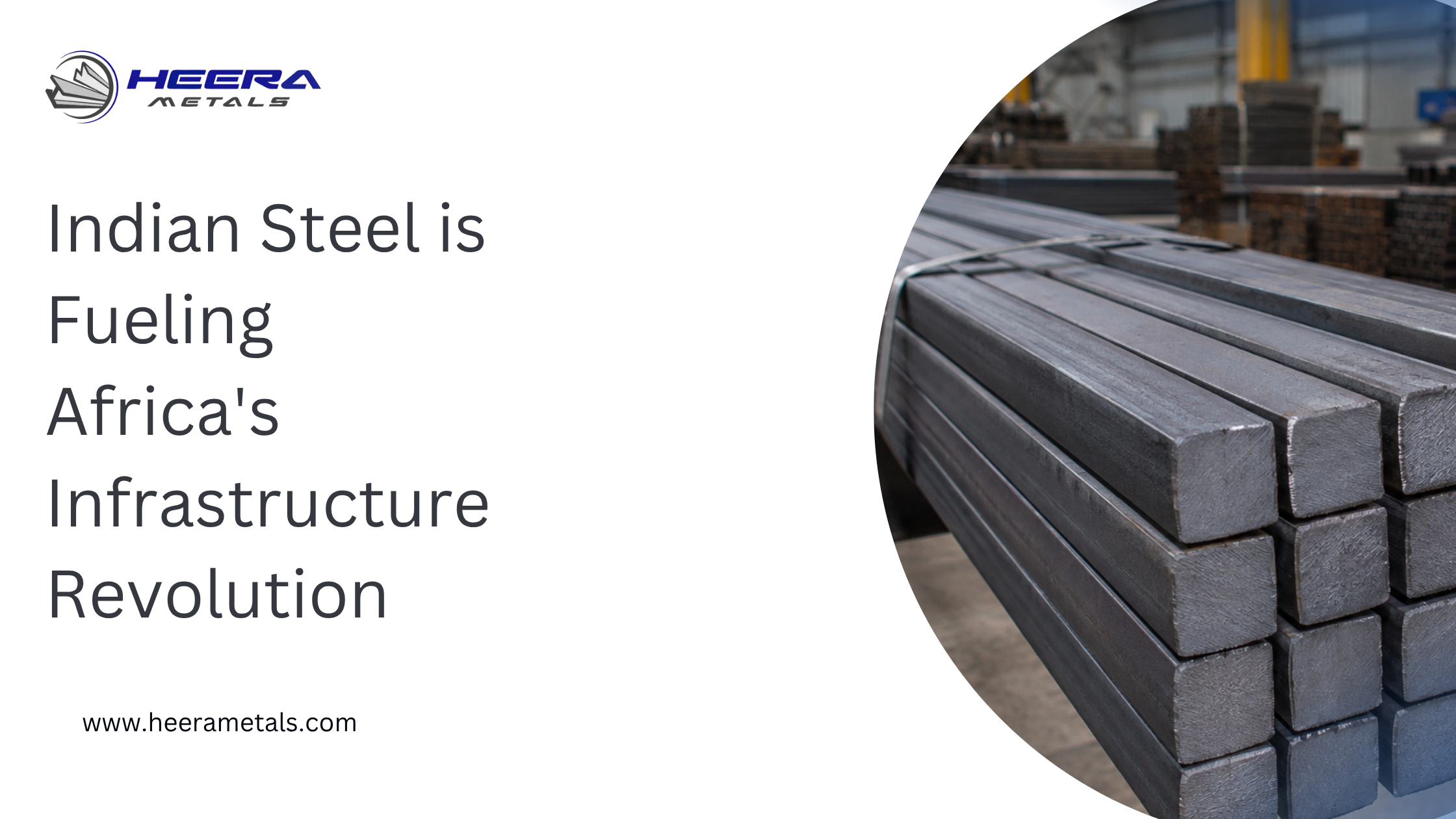
How Indian Steel is Fueling Africa’s Infrastructure Revolution
A Continent on the Rise and the Steel Behind It
Africa is building. From elevated highways cutting through Nairobi to new port terminals rising along the West African coast, from solar farms stretching across the Sahel to rail corridors connecting landlocked nations to global markets the continent is in the midst of one of the most ambitious infrastructure expansions in modern history.
But infrastructure doesn’t build itself. It demands steel enormous quantities of high-quality, cost-effective, reliable steel. And increasingly, that steel is coming from one source: India.
Indian steel exports to Africa have surged over the past decade, transforming the India-Africa steel trade into one of the most consequential commercial partnerships in the global construction supply chain. Indian steel manufacturers backed by world-class production facilities, competitive pricing, and the logistical advantage of proximity have positioned themselves as the preferred supplier for Africa’s infrastructure revolution.
This article explores how Indian steel in Africa is shaping roads, railways, bridges, and buildings across the continent, and why this partnership is set to deepen further in the years ahead.
The Scale of Africa’s Infrastructure Demand
To understand why Indian steel for African infrastructure has become so critical, you first need to appreciate the sheer scale of what Africa is trying to build.
The African Development Bank estimates that the continent faces an annual infrastructure funding gap of $68 to $108 billion. Governments, development finance institutions, and private investors are channelling capital into:
- Transport networks: Roads, rail corridors, ports, and airports
- Energy infrastructure: Power generation, transmission lines, and renewable energy installations
- Urban development: Housing, commercial real estate, and public buildings
- Water and sanitation: Dams, pipelines, and treatment facilities
Each of these sectors is a voracious consumer of construction-grade steel beams, bars, plates, sections, and structural profiles. The demand is not a short-term spike; it reflects decades of underinvestment and a rapidly urbanising population projected to reach 2.5 billion by 2050.
Africa needs steel partners who can deliver at scale, reliably, and at a price that makes large-scale construction projects financially viable. That is precisely the value proposition that Indian steel industry players have built their African strategy around.
Why Africa Imports Steel from India: The Competitive Advantage
Cost-Effective Production at Industrial Scale
India is one of the world’s largest steel producers, with an annual output exceeding 125 million metric tonnes. This production scale translates directly into competitive pricing for buyers and for African nations operating within tight infrastructure budgets, affordable steel for infrastructure is not a luxury, it’s a necessity.
Indian steel manufacturers have invested heavily in modernising blast furnaces, electric arc furnaces, and rolling mills, driving down per-unit production costs while maintaining quality standards aligned with international specifications. The result is construction steel solutions that match or exceed what European or East Asian competitors offer, at a substantially lower landed cost.
Geographic and Logistical Proximity
India’s location along major Indian Ocean shipping routes places it at a natural advantage over Western suppliers for East African markets. Ports in Mumbai, Mundra, Visakhapatnam, and Paradip maintain regular freight connections to Mombasa, Dar es Salaam, Durban, and Djibouti key entry points for steel supply for African projects.
Shorter transit times reduce financing costs on in-transit inventory, lower the risk of project delays caused by supply chain disruptions, and give African project managers greater scheduling flexibility. In large-scale construction projects where timelines are contractually binding, that reliability carries real commercial value.
Product Range and Customisation
Indian steel manufacturers produce the full spectrum of structural steel products demanded by infrastructure developers:
- TMT bars and rebars for reinforced concrete structures
- Steel beams, columns, and channels for structural framing
- Steel plates and sheets for fabrication applications
- MS angles, flats, and rounds for secondary structural and mechanical use
- Railway sections including rails, fish plates, and sleeper clips
The ability to source this diversity from a single origin simplifies procurement, reduces coordination complexity, and enables better bulk pricing all factors that make Indian steel preferred in African infrastructure projects.
How Indian Steel Supports Railway and Bridge Construction in Africa
Among the most visible expressions of India-Africa steel trade are the continent’s expanding railway and bridge construction programmes.
Railway Infrastructure
Rail is central to Africa’s economic integration ambitions. The Standard Gauge Railway in Kenya, the Abuja Light Rail in Nigeria, the Addis Ababa-Djibouti Railway, and emerging rail corridors across Southern Africa all depend on heavy construction steel for track, bridges, viaducts, and station structures.
Indian steel for railways and bridges brings a significant advantage: India’s own railways the world’s fourth largest network have driven domestic production of high-specification rail sections for over a century. That institutional knowledge translates into export products engineered to perform under heavy axle loads, tropical temperatures, and demanding track geometry.
Indian steel manufacturers supply rolled rail sections, structural steel for rail bridges, and fabricated components that meet the UIC, AREMA, and EN standards specified by African rail project contracts.
Bridge Construction
Bridge projects across Africa from pedestrian footbridges in rural communities to major road and rail crossings over the Zambezi, Niger, and Congo rivers rely on structural steel applications including girders, trusses, bearings, and expansion joints.
Indian steel industry players have supplied fabricated steel components to bridge projects in Ethiopia, Tanzania, Mozambique, Ghana, and Zambia. The combination of engineering capability, manufacturing capacity, and export logistics has made India a go-to sourcing destination for African bridge programmes.
Indian Steel’s Role Across Key African Infrastructure Sectors
The impact of Indian steel exports for African construction extends far beyond rail and bridges.
Urban and Commercial Development
Africa’s cities are growing faster than almost any urban centres on Earth. This commercial and residential development boom demands reinforcing steel for concrete high-rises, structural steel for commercial buildings, and engineering materials for public infrastructure like hospitals, schools, and government facilities.
Indian TMT bars produced to Fe 415, Fe 500, and Fe 550 grades are widely specified by African contractors for their consistent yield strength, ductility, and bondability with concrete. Indian steel manufacturers have developed export-grade packaging and documentation protocols specifically designed for the African market.
Energy Infrastructure
From hydroelectric dams in the DRC to wind farms in South Africa and solar installations in Morocco, transportation and energy infrastructure projects consume substantial quantities of structural steel. Tower foundations, transmission line pylons, substation structures, and pipeline supports all depend on heavy construction steel delivered to specification and on schedule.
Indian suppliers have built track records across several major African energy projects, establishing the reliability and technical credibility that project financiers and EPC contractors require before committing to a supply relationship.
Port and Logistics Infrastructure
Africa’s port expansion driven by rising trade volumes and the imperative to reduce logistics costs requires steel piling, quay structures, crane rails, and warehouse frameworks. Indian steel fabrication solutions, engineered to marine environment specifications, have found growing application in port development projects across the continent.
The Impact of Indian Steel on Africa’s Economic Growth
The India-Africa steel trade is not simply a commercial transaction. It is a driver of economic development projects with multiplier effects across African economies.
When steel arrives reliably and affordably, construction timelines are met. When infrastructure is delivered on schedule, the economic returns reduced transport costs, faster goods movement, improved energy access, expanded industrial capacity begin accruing sooner.
Beyond the direct supply relationship, cross-border trade partnerships between Indian steel companies and African distributors, traders, and fabricators are creating local business ecosystems. Warehousing, processing, distribution, and fabrication businesses that handle Indian steel imports are generating employment and building technical capability across African markets.
Several Indian steel manufacturers have gone further, establishing local partnerships, joint ventures, and service centres in key African markets deepening the relationship beyond export-import into genuine industrial expansion in Africa.
Why Indian Steel is Preferred in African Infrastructure Projects
Summarising the structural reasons behind the preference:
- Price competitiveness: Lower production costs enable competitive landed pricing against all major alternative origins
- Quality consistency: ISO-certified manufacturing with third-party inspection options satisfies project lender requirements
- Scale of supply: Ability to fulfil large tonnage orders within project timelines without supply interruption
- Product breadth: Full range of steel beams and bars, structural sections, and specialised profiles from a single origin
- Technical support: Indian manufacturers increasingly offer pre-sales technical assistance, mill certificates, and post-delivery support
- Sustainable construction materials: Growing adoption of energy-efficient steelmaking processes aligned with green infrastructure financing requirements
The Future of India-Africa Steel Trade
The trajectory of infrastructure growth in Africa points firmly upward. The African Continental Free Trade Area (AfCFTA), once fully operational, will accelerate cross-border infrastructure investment, amplifying demand for steel across the continent.
India, meanwhile, is targeting 300 million metric tonnes of annual steel production capacity by 2030 a scale that will further enhance cost competitiveness and supply reliability for export markets.
The global steel supply chain is shifting. As African nations prioritise infrastructure-led economic transformation and Indian manufacturers seek to expand export revenue, the alignment of interests is clear. India-Africa steel trade partnerships are not opportunistic they are strategic, long-term, and mutually reinforcing.
Indian steel exports to Africa are set to grow in volume, in product sophistication, and in the depth of commercial and technical relationships that underpin them.
Conclusion: Steel as the Foundation of a Shared Future
Africa’s infrastructure revolution is real, it is accelerating, and it is reshaping the economic geography of the continent. At its foundation literally and figuratively is steel. And increasingly, that steel carries the mark of Indian manufacturing.
The role of Indian steel in Africa goes beyond filling a supply gap. It reflects a maturing partnership between the world’s most populous nation and the world’s fastest-growing continent two economic forces whose futures are increasingly intertwined.
For African governments and project developers, Indian steel for African infrastructure offers the combination of quality, affordability, scale, and reliability that ambitious infrastructure programmes demand. For Indian steel manufacturers, Africa represents a high-growth export market that rewards long-term commitment and technical partnership.
Are you involved in an African infrastructure project requiring structural steel supply?
Connect with established Indian steel exporters with proven African market experience, third-party certified product quality, and the logistics capability to deliver on time wherever in Africa your project is located.



Leave a Reply