
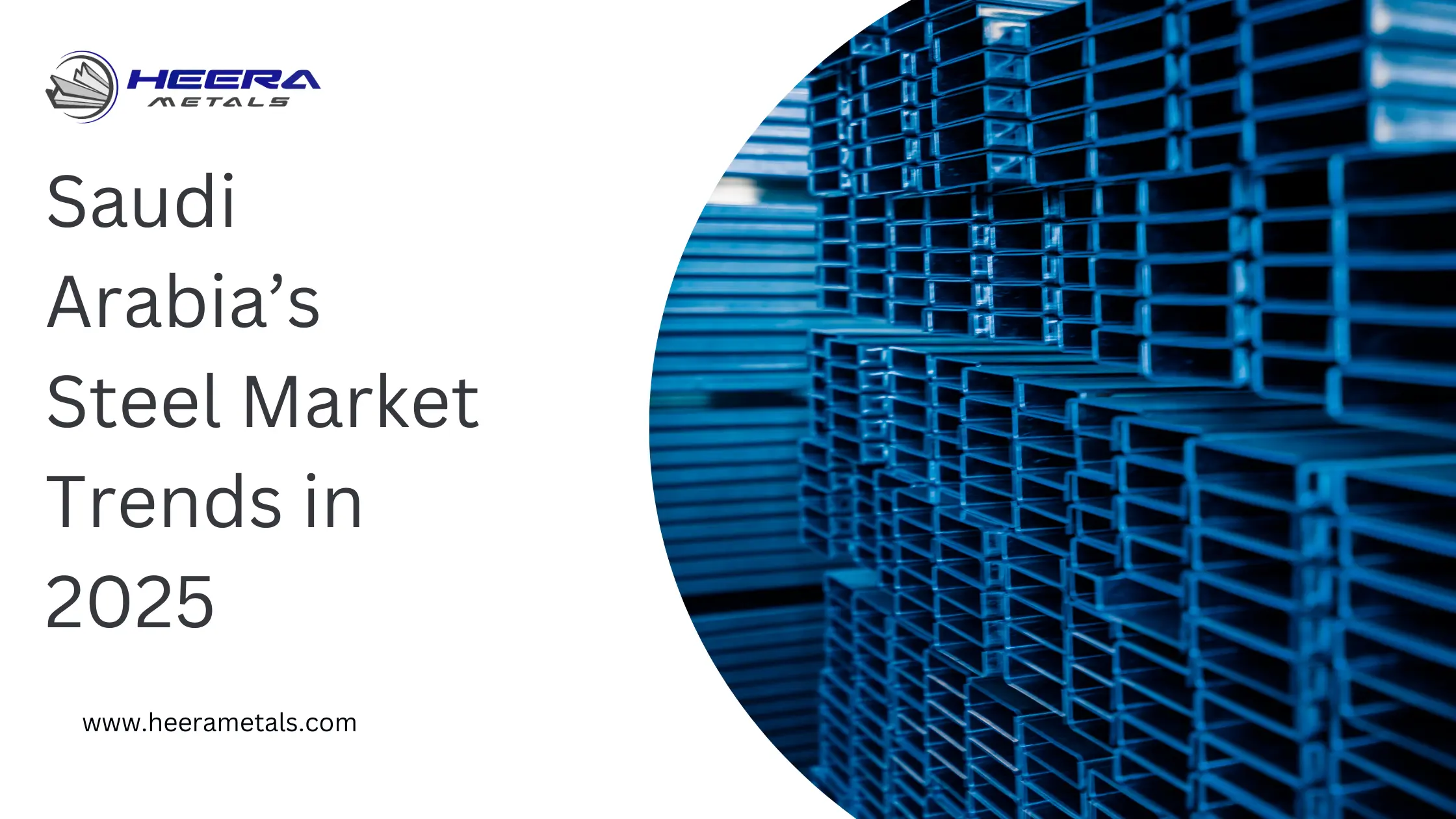
Understanding Saudi Arabia’s Steel Market Trends in 2025
As the Kingdom speeds up its transformation under Vision 2030, Saudi Arabia’s steel industry continues to grow in 2025. The demand for steel, particularly mild steel, is still at an all-time high thanks to massive construction, industrial growth, and mega-developments like NEOM, The Line, Quiddity, Diriyah Gate, and Red Sea Global. Supported by increasing domestic production and consistent imports to meet growing demand across infrastructure, housing, manufacturing, and energy projects, the sector has developed into one of the most active in the Middle East.
The Saudi steel market is expected to reach multi-billion-dollar levels in 2025, supported by a solid annual growth rate driven by rising steel demand across the Kingdom. With major investments from both public and private sectors, mild steel consumption, structural steel requirements, and overall industrial steel usage continue to surge. Rapid expansion of industrial zones, renewable energy projects, logistics hubs, and large-scale urban development is further accelerating the construction steel market. With this strong upward momentum, Saudi Arabia’s steel industry stands firmly as a regional powerhouse, shaping the manufacturing, infrastructure, and construction landscape across the GCC.
Saudi Arabia Steel Market Outlook 2025: Price Trends for Mild & Structural Steel per Ton and Key Market Drivers (Import Costs, Raw Materials, Demand)
In 2025, the steel market in Saudi Arabia is navigating a landscape of both stability and subtle shifts. For instance, Saudi Iron & Steel Company (Hadeed) maintained its long‐steel product pricing at the start of the year: rebar (12-32 mm) held at SAR 2,400/tonne (~US$639) and wire rod (6.5-16 mm) stayed at SAR 2,440 (~US$649) for January deliveries. Meanwhile, the entry of credible benchmarking tools is emerging: a monthly import‐price assessment for steel billets (CFR Saudi Arabia) was introduced in September 2025, offering a clearer picture of landed cost pressure from imports.
Key drivers affecting price trends include:
- Import dynamics: Saudi Arabia still relies heavily on imports for certain steel inputs, particularly billets, which means global freight, exchange rates, and input costs affect domestic pricing.
- Raw‐material volatility: Fluctuations in scrap, iron-ore and energy costs feed into domestic price pressure.
- Domestic supply stability: With major producers holding prices steady, pricing pressure has been somewhat muted in early 2025.
- Transparency improvements: The rollout of formal indices and assessments improves visibility for buyers and sellers in the market.
Overall, the combination of import cost pressures and rising demand from infrastructure and construction projects points to an underlying upward drift for steel prices in Saudi Arabia, even though significant price jumps are not visible in early 2025. To predict future price changes, stakeholders should closely monitor import parity levels, freight and currency developments, and raw-material cost trends.
Rising Demand for Mild Steel in Saudi Arabia
Why Mild Steel Is Preferred for Construction Projects in KSA
Because of its consistent strength, superior ductility, and economical performance, mild steel is still the most popular option for construction in Saudi Arabia. It is perfect for beams, columns, structural frames, and reinforcement work due to its adaptable mild steel qualities, ease of welding, and ease of fabrication. Because mild steel is readily available in a variety of grades, including IS 2062, and has a stable price on the market, builders also favor it for construction. Using robust, low-carbon mild steel guarantees long-term dependability, safety, and effective project execution as KSA speeds up mega-projects under Vision 2030.
Top Industrial Uses of Mild Steel in Saudi Arabia 2025
In 2025, Mild Steel plays a vital role across Saudi Arabia’s fast-growing industrial sectors. Its durability, strength, and affordability make it essential for construction steel, fabrication work, machinery manufacturing, and large-scale infrastructure projects. Industries rely on mild steel plates, pipes, round bars, and structural sections for equipment frames, storage tanks, pipelines, and heavy engineering components. With major growth in oil & gas, renewable energy, logistics, and industrial zones, demand for low-carbon steel and versatile mild steel products continues to rise.
High-Demand Steel Products in the Saudi Market
Usage of MS Angles, MS Channels, and MS Beams in Construction
Because of their strength, stability, and adaptability, MS Angles, MS Channels, and MS Beams are crucial mild steel components that are extensively utilized in Saudi Arabia’s construction industry. Frameworks, brackets, and edge reinforcement are supported by MS Angles. Because of their superior load-bearing capacity, MS Channels are recommended for cable trays, wall supports, and flooring systems. When it comes to heavy structural work, such as building skeletons, trusses, and columns, MS Beams are essential. These sections guarantee longevity, ease of fabrication, and dependable performance in residential, commercial, and industrial construction projects due to the growing demand for mild steel structures.
Increasing Need for Steel Bars, Rods, and Rebars in Giga-Project
Saudi Arabia’s giga-projects such as NEOM, The Line, and Qiddiya are driving a massive rise in demand for steel bars, rods, and rebars, especially high-strength MS Bars and Rods used in foundations, columns, and high-load structures. These mega-developments also require durable MS Black Pipe for water systems, irrigation lines, and industrial piping. Additionally, MS Square Bar is widely used in fabrication, frameworks, gates, and heavy structural components. With rapid expansion across infrastructure, housing, and industrial zones, the consumption of these mild steel products continues to accelerate, ensuring reliable performance and long-term stability in giga-scale construction.
Import Trends and Supply Chain Insights for 2025
Saudi Arabia’s steel imports continue to rise as demand for mild steel products outpaces local production, especially for MS Bars and Rods, MS Black Pipe, MS Square Bar, hot-rolled coils, and billets. Key sourcing markets such as India, China, Turkey, and the UAE supply large volumes to support giga-project timelines. On the supply chain side, improved port capacity, faster customs clearance, and digital logistics systems help streamline steel movement. Contractors are relying more on diversified suppliers, long-term contracts, and smart inventory planning to ensure uninterrupted availability and stable pricing across Saudi Arabia’s expanding construction and industrial sectors.
Why Indian Mild Steel Exporters Are Gaining Ground in the Saudi Market
Indian mild steel exporters are growing significantly in Saudi Arabia. In order to guarantee complete adherence to Saudi construction and industrial standards, many suppliers now offer globally recognized certifications like IS 2062, BIS, ISO 9001, and third-party inspection approvals. This lowers approval delays for large projects and increases buyer confidence.
Another important factor is cost advantage; exporters can offer extremely competitive pricing while maintaining premium quality thanks to India’s effective manufacturing ecosystem. Additionally, exporters place a strong emphasis on safety assurance, offering traceability, complete documentation, and Mill Test Certificates for each batch.These elements, along with better logistics planning, quicker delivery schedules, and more robust trade relationships, are assisting Indian mild steel suppliers in establishing a more robust and dependable presence in the KSA market.
Conclusion: Key Market Trends and Their Importance for Steel Buyers & Suppliers in Saudi Arabia
With the help of Vision 2030, giga-project expansion, and quick industrial diversification, Saudi Arabia’s steel market is about to enter one of its strongest phases in 2025. Mild steel, which is prized for its strength, versatility, affordability, and dependability in infrastructure, manufacturing, and construction, continues to be at the center of this momentum. The Kingdom’s steel ecosystem is becoming more open, effective, and competitive as domestic production increases and imports continue to sustain demand spikes.
As the demand for MS Bars, Rods, structural sections, and industrial-grade steel increases, suppliers particularly those from India are solidifying their position through improved safety documentation, consistent pricing, and certified quality. When taken as a whole, these developments establish Saudi Arabia as the GCC’s top steel-consuming hub, guaranteeing consistent growth, reliable supply chains, and long-term prospects for regional and international steel stakeholders.




Leave a Reply